Showing posts with label apostles. Show all posts

Tuesday, November 30, 2010

Happy St. Andrews Day!

Readings:

Psalm 19 or 19:1-6
Deuteronomy 30:11-14
Romans 10:8b-18
Matthew 4:18-22

Preface of Apostles

Collect: Almighty God, who gave such grace to your apostle Andrew that he readily obeyed the call of your Son Jesus Christ, and brought his brother with him: Give unto us, who are called by your Word, grace to follow him without delay, and to bring those near to us into his gracious presence; who lives and reigns with you and the Holy Spirit, one God, now and for ever.

Icon of St. AndrewMost references to Andrew in the New Testament simply include him on a list of the Twelve Apostles, or group him with his brother, Simon Peter. But he appears acting as an individual three times in the Gospel of John. When a number of Greeks (perhaps simply Greek-speaking Jews) wish to speak with Jesus, they approach Philip, who tells Andrew, and the two of them tell Jesus (Jn 12:20-22). (It may be relevant here that both "Philip" and "Andrew" are Greek names.) Before Jesus feeds the Five Thousand, it is Andrew who says, "Here is a lad with five barley loaves and two fish." (Jn 6:8f) And the first two disciples whom John reports as attaching themselves to Jesus (Jn 1:35-42) are Andrew and another disciple (whom John does not name, but who is commonly supposed to be John himself -- John never mentions himself by name, a widespread literary convention). Having met Jesus, Andrew then finds his brother Simon and brings him to Jesus. Thus, on each occasion when he is mentioned as an individual, it is because he is instrumental in bringing others to meet the Saviour. In the Episcopal Church, the Fellowship of Saint Andrew is devoted to encouraging personal evangelism, and the bringing of one's friends and colleagues to a knowledge of the Gospel of Christ.

Just as Andrew was the first of the Apostles, so his feast is taken in the West to be the beginning of the Church Year. (Eastern Christians begin their Church Year on 1 September.) The First Sunday of Advent is defined to be the Sunday on or nearest his feast (although it could equivalently be defined as the fourth Sunday before Christmas Day).

Several centuries after the death of Andrew, some of his relics were brought by a missionary named Rule to Scotland, to a place then known as Fife, but now known as St. Andrew's, and best known as the site of a world-famous golf course and club. For this reason, Andrew is the patron of Scotland.

When the Emperor Constantine established the city of Byzantium, or Constantinople, as the new capital of the Roman Empire, replacing Rome, the bishop of Byzantium became very prominent. Five sees (bishoprics) came to be known as patriarchates: Rome, Alexandria, Antioch, Jerusalem, and Byzantium. Now, the congregation at Rome claimed the two most famous apostles, Peter and Paul, as founders. Antioch could also claim both Peter and Paul, on the explicit testimony of Scripture, and of course Jerusalem had all the apostles. Alexandria claimed that Mark, who had been Peter's "interpreter" and assistant, and had written down the Gospel of Mark on the basis of what he had heard from Peter, had after Peter's death gone to Alexandria and founded the church there. Byzantium was scorned by the other patriarchates as a new-comer, a church with the political prestige of being located at the capital of the Empire, but with no apostles in its history. Byzantium responded with the claim that its founder and first bishop had been Andrew the brother of Peter. They pointed out that Andrew had been the first of all the apostles to follow Jesus (John 1:40-41), and that he had brought his brother to Jesus. Andrew was thus, in the words of John Chrysostom, "the Peter before Peter." As Russia was Christianized by missionaries from Byzantium, Andrew became the patron not only of Byzantium but also of Russia.

Andrew is the national saint of Scotland (thus appreciated, even by Presbyterians! - Ed.). George (23 Apr) is the national saint of England, Patrick (17 Mar) of Ireland, and Dewi = David (1 Mar) of Wales. George, who was a soldier, is customarily pictured as a knight with a shield that bears a red cross on a white background. This design is therefore the national flag of England. It is said that Andrew was crucified on a Cross Saltire -- an 'X' -shaped cross. His symbol is a Cross Saltire, white on a blue background. This is accordingly the national flag of Scotland. A symbol of Patrick is a red cross saltire on a white background. The crosses of George and Andrew were combined to form the Union Jack, or flag of Great Britain, and later the cross of Patrick was added to form the present Union Jack. Wales does not appear as such (sorry!). Whether there is a design known as the cross of David, I have no idea.

by James Kiefer

Tuesday, August 24, 2010

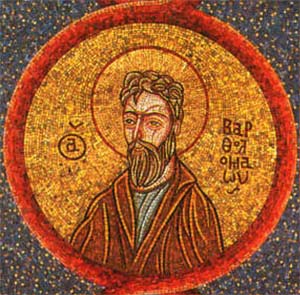
Feast of St. Bartholomew, Apostle

The name "Bartholomew" appears in the New Testament only on lists of the names of the twelve apostles. This list normally is given as six pairs, and the third pair in each of the Synoptics is "Philip and Bartholomew" (M 10:3; P 3:18; L 6:14; but A 1:15).


John gives no list of the Twelve, but refers to more of them individually than the Synoptists. He does not name Bartholomew, but early in his account (John 1:43-50) he tells of the call to discipleship of a Nathaniel who is often supposed to be the same person. The reasoning is as follows: John's Nathanael is introduced as one of the earliest followers of Jesus, and in terms which suggest that he became one of the Twelve. He is clearly not the same as Peter, Andrew, James, John, Philip, Thomas, Judas Iscariot, Judas (not Iscariot, also called Lebbaeus or Thaddeus), all of whom John names separately. He is not Matthew, whose call is described differently (M 9:9). This leaves Bartholomew, James the son of Alpheus, and Simon Zelotes. Of these, Bartholomew is the leading candidate for two reasons:

(1) "Bar-tholomew" is a patronymic, meaning "son of Tolmai (or Talmai)." It is therefore likely that he had another name. (A historical novel which may not be well researched informs me that a first-century Jew would be likely to use the patronymic instead of the forename as a mark of respect in speaking to a significantly older Jew.) "Nathanael son of Tolmai" seems more likely than "Nathanael also called James (or Simon)."
(2) Nathanael is introduced in John's narrative as a friend of Philip. Since Bartholomew is paired with Philip on three of our four lists of Apostles, it seems likely that they were associated.

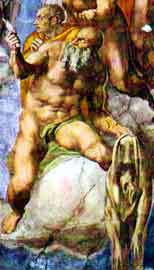
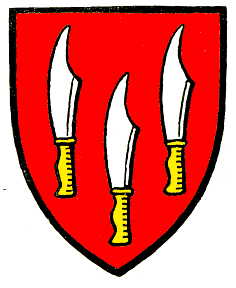
We have no certain information about Bartholomew's later life. Some writers, including the historian Eusebius of Caesarea (now Har Qesari, 32:30 N 34:54 E, near Sedot Yam), say that he preached in India. The majority tradition, with varying details, is that Bartholomew preached in Armenia, and was finally skinned alive and beheaded to Albanus or Albanopolis (now Derbent, 42:03 N 48:18 E) on the Caspian Sea. His emblem in art is a flaying knife. The flayed Bartholomew can be seen in Michelangelo's Sistine painting of the Last Judgement. He is holding his skin. The face on the skin is generally considered to be a self-portrait of Michelangelo.

Readings:

Psalm 91 or 91:1-4
Deuteronomy 18:15-18
1 Corinthians 4:9-15
Luke 22:24-30

Preface of Apostles

PRAYER (traditional language)

Almighty and everlasting God, who didst give to thine apostle Bartholomew grace truly to believe and to preach thy Word: Grant that thy Church may love what he believed and preach what he taught; through Jesus Christ our Lord, who liveth and reigneth with thee and the Holy Ghost, one God for ever and ever.

PRAYER (contemporary language)
Almighty and everlasting God, who gave to your apostle Bartholomew grace truly to believe and to preach your Word: Grant that your Church may love what he believed and preach what he taught; through Jesus Christ our Lord, who lives and reigns with you and the Holy Spirit, one God for ever and ever.

Saturday, July 31, 2010

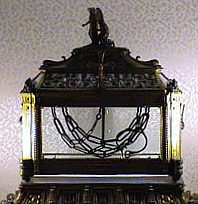
Feast of St. Peter's Chains (Lammas)


Please note that some Anglican Kalendars commemorate St. Joseph of Arimathaea on this day.

Collect

O GOD, who didst deliver thy holy Apostle Saint Peter from his bonds and suffer him to depart unhurt : vouchsafe, we pray thee ; to deliver us from the bonds of our sins, and of thy mercy preserve us from all evil. Through Jesus Christ, thy Son our Lord, who livest and reignest with thee, in the unity of the Holy Ghost, ever one God, world without end. Amen.

Hymn. Petrus beatus catenarum.

RIGHT wondrously set free, see, Peter freedom gains,
And at the Lord's command casts off his iron chains;
As shepherd and as guide he shews to life the way,
And from his Master's sheep drives guileful wolves away.

Now to the Trinity eternal glory sing,
All honour, virtue, might, and hymns of gladness bring.
He rules the universe in wondrous Unity,
And shall, through all the days of vast eternity. Amen.

For the legend

Veneration of St. Peter's ChainsTHE Apostle Peter was put in prison for the Name of the Lord Jesus, and bound with Chains ; and that not once only, nor in one place, but several times, and in divers places. In the Acts of the Apostles we read how, immediately after Pentecost, he and the Apostle John went up to the temple together ; and there, at the temple gate, he healed the lame man ; and afterwards, whilst he was speaking to the people, he and John were taken by the Jewish priests, out of envy, and put in hold, that is, in Chains, unto the next day. And when they were brought forth, on the morrow, Peter shewed such constancy in his witness of Christ, along with John, that the rulers themselves could not but admire the fearless boldness of these Apostles whom they esteemed as unlearned and ignorant men. And the faith of all those who heard of this matter was in such wise strengthened by the apostolic witness, and Peter's Chains, that the number of believers increased to five thousand.

IT was not so long a time after, when all kind of diseases were healed by the shadow of Peter only, passing by, that he was taken again, and with the other Apostles was put into the common prison, at the command of the high priests and Sadducees, and thus a second time he was bound with Chains. But the Angel of the Lord by night opened the prison doors and sent the Apostles forth to preach Christ, despite the prohibition of men. Whereupon Peter and the other Apostles were apprehended, and brought before the Council, and condemned to be beaten, in an attempt to make them obey men rather than God. The third time whereof we have record of Peter's Chains is after the death of James, when Herod perceived that the murder of this Apostle was not displeasing to the Jews, and so proceeded to take Peter also, and had him bound with two Chains, and kept in prison under the ward of four quaternions of soldiers. Wherefrom he was again wondrously delivered by an Angel.

LASTLY, when he suffered martyrdom at Rome, he was kept in the Mamertine prison, and is said to have been bound in Chains by the command of Nero, which Chains have been held in honour by the Church from the first ages. Further, Arator, Subdeacon of the Roman Church in the sixth century, wrote that the Chains wherewith Peter was bound at Jerusalem, or certainly some of them, were preserved at Rome in his own time, and consequently the veneration of Peter's Chains greatly increased ; especially when, as we learn from other records of the Church of Rome, a basilica was built by the younger Eudoxia, wife of Valentinian III, on the Esquiline Hill, under the name of Saint Peter in Chains. This temple, or a re-building of it, was dedicated on August 1st, whence the day was placed in the Kalendar as the Feast of Saint Peter's Chains, afterwards called in England Lammas Day, from the custom of offering loaves of bread made from the first-gathered grain of the year, in thanksgiving from the beginning of the harvest. And, because of his Chains, this holy Apostle is often invoked for those in bondage.

From the Anglican Breviary

Herod Agrippa, the grandson of Herod the Great and king of the Jews, grew wroth against the Church of Christ, and slew James, the brother of John the Evangelist. Seeing that this pleased the Jews, he took Peter also into custody and locked him up in prison, intending to keep him there until after the feast of the Passover, so that he could win the favour of the people by presenting him to them as a victim. But the Apostle was saved when he was miraculously set free by an Angel (Acts 12:1-19). The Chains wherewith the Apostle was bound received from his most sacred body the grace of sanctification and healing, which is bestowed upon the faithful who draw nigh with faith.

That such sacred treasures work wonders and many healings is witnessed by the divine Scripture, where it speaks concerning Paul, saying that the Christians in Ephesus had such reverence for him, that his handkerchiefs and aprons, taken up with much reverence, healed the sick of their maladies: "So that from his body were brought unto the sick handkerchiefs or aprons, and the diseases departed from them, and the evil spirits went out of them" (Acts 19:12). But not only the Apostles' clothing (which certainly touched the bodies of the sick), but even their shadow alone performed healings. On beholding this, people put their sick on stretchers and beds and brought them out into the streets that, when Peter passed by, his shadow "might overshadow some of them" (Acts 5:15). From this the Orthodox Catholic Church has learned to show reverence and piety not only to the relics of their bodies, but also in the clothing of God's Saints.

- From the Great Synaxarion by Holy Transfiguration Monastery.

For three centuries the Chains were kept in Jerusalem, and those afflicted with illness and approached them with faith received healing. Patriarch Juvenal presented the Chains to Eudokia, wife of the emperor Theodosius the Younger, and she in turn transferred them from Jerusalem to Constantinople in either the year 437 or 439.

Eudokia sent one Chain to Rome to her daughter Eudokia (the wife of Valentinian), who built a church on the Esquiline Hill dedicated to the Apostle Peter and placed the Chains in it. There were other Chains in Rome, such as that which had bound the saint during his nine month imprisonment in the Mamertine Prison near the Forum, with which the Apostle Peter was shackled before his martyrdom under the Emperor Nero. These were also placed in the church. It is said that when the pope compared the two Chains, they miraculously fused together into one unbreakable series of links. Because of this miracle, Empress Eudokia built the Basilica of Saint Peter in Chains (S. Peter ad Vincula or San Pietro in Vincoli), and dedicated it to the apostle in the year 442. The relic is now kept in a golden urn beneath the high altar, close to the famous statue of Michelangelo's Moses.

The basilica has undergone several restorations and rebuildings, including a restoration by Pope Adrian I, a rebuilding by Pope Sixtus IV and another by Pope Julius II. There was also a renovation in 1875. Some modernizations were made at that time.

Michelangelo's Moses, which dates from 1515, is the most notable piece of artwork in the basilica. Originally intended as part of a 40-statue funeral monument for Pope Julius II, Moses became the Pope's funeral monument and tomb in his family's church.

Further, Arator, Subdeacon of the Roman Church in the sixth century, wrote that the Chains wherewith Peter was bound at Jerusalem, or certainly some of them, were preserved at Rome in his own time, and consequently the veneration of Peter's Chains greatly increased; especially when, as we learn from other records of the Church of Rome, a basilica was built by the younger Eudokia, wife of Valentinian III, on the Esquiline Hill, under the name of Saint Peter in Chains. This temple, or a re-building of it, was dedicated on August 1st, whence the day was placed in the Roman Calendar as the Feast of Saint Peter's Chains, afterwards called in England Lammas (lit. loaf-mass) Day, from the custom of offering loaves of bread made from the first-gathered grain of the year, in thanksgiving from the beginning of the harvest. And, because of his Chains, this holy Apostle is often invoked for those in bondage.

When Constantine the Great became emperor of Rome and ended the persecutions against the Church, the Christians of Rome gathered the relics of the Apostle Peter together with the Chains that held him in prison in Rome, and a temple was dedicated to them by the emperor. The Chains were greatly venerated by the faithful, for just as the shadow of the apostle worked miracles so also did the Chains that held him. The relics of the Apostle Peter were placed on a throne in a hidden area of the temple to prevent its theft, and this area was only opened three times a year for Christians to go and venerate the apostle seated on his throne.

Saturday, May 1, 2010

Today we commemorate two of the Twelve Apostles, a festival moved from last week to accommodate Easter.


The New Testament mentions at least two persons named James, probably at least three, and perhaps as many as eight. This is as good a place as any to sort them out.

(1) JAMES THE GREATER: James the son of Zebedee, called James the Greater or James Major or James the Elder, was one of the Twelve Apostles, and also, along with his brother John and with Peter, belonged to what seems to have been an inner circle of Three. He was killed by order of King Herod, as reported in Acts 12:2. (See M 4:21; 10:2; 17:1; P 1:19,29; 3:17; 5:37; 9:2; 10:35,41; 13:3; 14:33; L 5:10; 6:14; 8:51; 9:28,54; A 11:13; 12:2)

St. James Minor, from a 1708 Book of Common Prayer(2) JAMES THE LESS: James the son of Alphaeus (Alpheus) appears on lists of the Twelve Apostles (usually in the ninth place), but is never mentioned otherwise. He is called James the Less, or James Minor, or James the Younger. (See M 10:3; P 3:18; L 6:15; A 1:13)

(3) JAMES THE JUST: James called "the brother of the Lord" appears in Acts 12:17 and thereafter (A 15:13; 21:18; 1C 15:17; Ga 1:19; 2:9,12) as the leader of the Jerusalem congregation. He is counted by later Church historians as the first bishop of Jerusalem, with Simeon (described as also a kinsman, something like a great-nephew of Joseph) as the second. According to the Jewish historian Josephus, James was put to death by order of the high priest during an interval between Roman governors, over the protests of the Pharisees, who thought him an upright man. He is known as James the Just or James of Jerusalem or James Protepiscopus (first bishop).

(4) JAMES THE WRITER: One of the New Testament Epistles is written by a James. (See Jas 1:1)

(5) JAMES THE SON OF CLEOPAS:
John (19:25) lists the women standing by the cross of Jesus as "his mother, and his mother's sister, Mary the wife of Clopas, and Mary Magdalene." If this list mentions only three women, then Mary the wife of Clopas is presumably a sister-in-law to the Virgin Mary.
The Synoptists give lists of women apparently at a distance.
Matthew (27:55f) lists as "looking on from afar" some Galilean women "among whom were Mary Magdalene, and Mary the mother of James and Joseph, and the mother of the sons of Zebedee."
Mark (15:40f) lists "Mary Magdalene and Mary the mother of James the Younger and of Joses, and Salome... and also many other women."
Luke (24:10) lists "Mary Magdalene and Joanna and Mary the mother of James and the other women with them."
By "mother of James..." do the Synoptists denote the mother of Jesus? It seems odd that they would omit to mention her if she were there, but odder yet that they would identify her as the mother of James and Joseph (Joses), but not as the mother of Jesus. Besides, we note that Matthew and Mark are speaking of women who stood at a distance, while the Virgin was close enough to hear her Son speak. I therefore assume that Mary the mother of James etc is not the same as the Virgin Mary, and is either not mentioned by John at all or is identical with his "Mary the wife of Clopas," who is probably the sister-in-law of the Virgin Mary. Conclusion: James the son of Clopas was perhaps the nephew of either Mary or Joseph, and so would have been known as the first cousin of Jesus.

(6) JAMES THE NAZARENE: The residents of Nazareth speak of brothers of Jesus, including one named James (M 4:55 = P 6:3).

(7) JAMES THE KINSMAN OF JUDE THE APOSTLE: When Luke lists the Apostles (L 6:16; A 1:13), he has, in places 9 thru 11, "James the son of Alphaeus, Simon the Zealot, and Judas of James." [This is not Judas Iscariot.] Now, "Judas of James" would ordinarily mean "Judas son of James," and so the RSV translates it. However, the KJV renders is as "Judas the brother of James," and some suppose him to be the brother of James the son of Alphaeus, so that we have no fewer than three pairs of brothers among the disciples: Peter and Andrew, sons of Jonas; James and John, sons of Zebedee; James and Jude, sons of Alphaeus. This seems unlikely, since (a) if Luke had intended us to understand that the two were brothers, he would have written them together instead of separating them by Simon the Zealot (but note P 3:16-18); and (b) if he had meant us to understand "brother of" rather than the more usual "son of", he would have said "brother."

(8) JAMES THE BROTHER OF JUDE THE WRITER: The author of the Epistle of Jude calls himself the brother of James. Presumably this James would be someone well-known to his readers, otherwise why bother to mention him?

Is any of these the same person as one or more of the others?

It is natural to suppose that James the Just (3) and James the Nazarene (6), being both called brothers of Jesus, must be the same person. However, the Hebrew word for "brother" is used more elastically than its English equivalent, often referring (for example) to cousins or even more distant relatives (see Leviticus 10:1-4, where Moses speaks to Mishael and Elphazan about their brothers, meaning the sons of their cousin). If early Christians for whom Aramaic was the primary language, and Greek secondary, retained this usage when they spoke Greek, then there is room for doubt on the point. Perhaps one of them was a cousin of Jesus rather than a brother. Perhaps both were cousins, in which case they could be the same person but need not have been.

The sons of Cleopas would have been nephews of either Joseph or Mary, and therefore may have been the "brothers" mentioned elsewhere. Thus James the son of Cleopas (5) may be identical with James the Just (3) or James the Nazarene (6) or both.

It is tempting to identify James the son of Alphaeus (2) with James the son of Cleopas (5) by supposing that "Cleopas" and "Alphaeus" are two different attempts to reproduce the same Semitic name (probably beginning with an Ayin) in Greek, but linguists mostly think this very doubtful. James son of Cleopas is called James the Less (Minor, Younger) in Mark 15:40, and James Son of Alphaeus is also called James the Less in popular usage, partly because the two are assumed to be the same, and partly because of the need to distinguish the two Apostles both named James.

The Epistle of James is addressed to Jewish readers, and James the Just (3) seems to have been particularly concerned with the Jewish Christian community. It is accordingly plausible, and customary, to identify James the Just (3) with James the Writer (4).

Many writers identify James the Less (2) with James the Just (3). A difficulty with that identification is that we are told that the brothers of Jesus did not believe in him (J 7:5), which would mean that they could not have been numbered among the Twelve. (It is commonly supposed that James (3) came to believe only after the Resurrection (1C 15:7).) On the other hand, John does not name the unbelieving brothers, and they may not have included James.

It is tempting to suppose that a pair of brothers named James and Jude are the same as another pair of brothers named James and Jude, if there is no obvious objection to identifying them. (This is not necessarily a valid inference, since the selection of names can be influenced by fashion. I have no difficulty, for example, in thinking of six families I know with brothers named David and Michael.) Accordingly, it has been customary to identify the two Apostles "James the son of Alphaeus" and "Judas (the brother) of James" with the two brothers mentioned in the Nazareth account, and also with the Jude who wrote the Epistle and his brother James, taken to be the same James who wrote the Epistle of James. On our list, this identifies James the Less (2), James the Nazarene (6), James the Kinsman of Jude the Apostle (7), and James the Brother of Jude the Writer (8), and probably James the Son of Cleopas (5). However, it should be noted that the most natural understanding of "Judas of James" is "Judas son of James," and that there is therefore no reason to suppose that James the son of Alphaeus has a brother named Jude.

Currently, most Western Christians commemorate:
(1) James the Greater on 25 July,
(2) James the Less on 1 May, and
(3) James the Just on 25 October.

They identify the others with (3) or ignore them. It will be generally conceded concerning (5), (6), (7), and (8) that if they are not the same as one of the others then there is no reason to remember them, so that the most one could reasonably do is add a fourth date for James the Writer. However, it is standard (and, I think, reasonable) to identify (4) with (3), and that leaves three commemorations, which is the current standard in the West, and also (I think) in the East. (Formerly the West identified (2) and (3).)

Thus, of James the Less, the son of Alphaeus (2), whom we commemorate today, we know very little from the New Testament, except that his name appears on lists of the Twelve.

Why is the name "James" so popular among Jews in New Testament times? Because it is the name of the ancestor of the people of Israel. The English name "James" is a variant of the name "Jacob." We tend to think of them as two separate, unrelated names. But the distinction between them is post-Biblical and not found in Hebrew or Greek. In Hebrew, the name is Ya'akov. In Greek, it is Iakwbos (W=Omega), with accent on the second syllable from the end. In Latin, it developed two forms, Jacobus and Jacomus, both accented on the first syllable. From the former, we have the English Jacob and the Spanish Diego and Iago. From the latter, we have the English James, the Scottish Hamish, the Spanish Jaime, and so on. But in many languages, there is only one name, given to the Old Testament Jacob and the New Testament James alike. Even in English, our present distinction has not always been observed. In Shakespeare's play MEASURE FOR MEASURE (III,ii,204), a child's age is given as "a year and a quarter old, come Philip and Jacob," meaning, "a year and a quarter old on the first of next May, the feast of Philip and James."


St. Philip, from a 1708 Book of Common PrayerPhilip the Apostle is frequently confused with Philip the Deacon, whom we read of in the Book of Acts (A 6:7; 8:5-40; 21:8f), and who is commemorated on 6 June. For arguments that they are in fact the same, see that BIO.

Philip the Apostle appears in the Synoptic Gospels and in Acts only as a name on the list of the Twelve, but he appears in several incidents in the Gospel according to John. He was called early in the ministry of Our Lord (J 1:44), and promptly brought his friend Nathanael to Jesus as well. When some Greeks (or Greek-speaking Jews) wished to speak with Jesus, they began by approaching Philip (J 12:20ff).
At the Last Supper (J 14:8f), he said to Jesus, "Lord, show us the Father, and we shall be satisfied." To this Jesus answered, "He who has seen me has seen the Father."
Before feeding the Five Thousand (J 6:5), Jesus turned to Philip and asked him, "Where can we buy bread to feed these people?" Philip answered, "It would take more than a year's wages to buy each of them a mouthful."

Some scholars have thought it significant that Jesus asked Philip rather than one of the others. Luke (9:10) tells us that the Feeding of the Five Thousand took place near Bethsaida, and John (1:44) tells us that Philip is from Bethsaida. If they were in Philip's home neighborhood, he would be a natural one to ask for directions. (Peter and Andrew were also from Bethsaida, but seem to have moved to Capernaum.) It seems that John named Philip here for one of three reasons:
(1) He was making up the details, and he said to himself: "I will name Philip here, and hope that my readers have read Luke and will remember that this is all happening near Bethsaida, and I will point out at the beginning of my work that Philip is from Bethsaida, and I will hope that the readers are clever enough to put this together and see that Philip is a logical person to ask. But I won't mention Bethsaida in this episode, since that would make it too obvious what I am doing."
(2) He chose one of the disciples at random, and by good luck made an appropriate choice.
(3) He was an eyewitness, or for some other reason well informed, and mentioned Philip by name because that was whom Jesus asked.

This is one reason (not the only one) for regarding the Gospel of John as the testimony of an eyewitness. For an elaboration, . . . look for essays with those names on this Web Page,

But I digress. That is the limit of what we hear of Philip and James in the New Testament, nor do other sources help much. One story says that Philip preached in Phrygia and died in Hierapolis, and that his remains were brought to Rome and buried in the Basilica of the Twelve Apostles (an ancient inscription shows that this church was formerly dedicated to Philip and James).

Readings:

Psalm 119:33-40;
Isaiah 30:18-21;
2 Corinthians 4:1-6
;
John 14:6-14

Preface of Apostles


PRAYER (traditional language)
Almighty God, who didst give to thine apostles Philip and James grace and strength to bear witness to the truth: Grant that we, being mindful of their victory of faith, may glorify in life and death the Name of our Lord Jesus Christ; who liveth and reigneth with thee and the Holy Spirit, one God, now and for ever.

PRAYER (contemporary language):
Almighty God, who gave to your apostles Philip and James grace and strength to bear witness to the truth: Grant that we, being mindful of their victory of faith, may glorify in life and death the Name of our Lord Jesus Christ; who lives and reigns with you and the Holy Spirit, one God, now and for ever.

(h/t to James Kiefer's invariably useful biographies.)