Showing posts with label kalendar. Show all posts

Monday, December 6, 2010

Happy St. Nicholas Day!

FRIEND OF CHILDREN, GIVER OF GIFTS, CLIMBER OF CHIMNEYS, ETC. (6 DEC 326)

The story of St. Nicholas offers a possible way of dealing with the "Santa Claus" problem, to parents who do not want to lie to their children, even in fun, but do not want to say simply: "Bah, humbug! There is no such thing as Santa. Forget about him."

Nicholas was a native of the western part of what is now Asiatic Turkey. He became Bishop of Myra in the fourth century, and there are many stories of his love for God and for his neighbor.

The best-known story involves a man with three unmarried daughters, and not enough money to provide them with suitable dowries. This meant that they could not marry, and were likely to end up as prostitutes. Nicholas walked by the man's house on three successive nights, and each time threw a bag of gold in through a window (or, when the story came to be told in colder climates, down the chimney). Thus, the daughters were saved from a life of shame, and all got married and lived happily ever after.

Because of this and similar stories, Nicholas became a symbol of anonymous gift-giving. Hence, if we give a gift to someone today without saying whom it is from, it can be called "a present from Saint Nicholas (or Santa Claus)." Some parents explain this to their children and invite the child to join them in wrapping a toy (either something purchased for that purpose, at least partly with the child's allowance, or else a toy that the child has outgrown but that is still serviceable) or an outgrown but not shabby item of the child's clothing, or a package of food, and then going along to donate it to a suitable shelter that will give it to someone who will welcome it. This gift is then called "a present from Santa," so that the child understands that this is another name for an anonymous gift given to someone whom we do not know, but whom we love anyway because God does. (Presents within the family can be "From Santa" or "From Santa and...")

Pictures of Nicholas often show three bags of gold next to him, and often these bags have become simply three disks or balls. Nicholas became the patron of an Italian city (I think Bari, which is where his body is now buried) that was a center of the pawnbroking business, and hence a pawnbroking shop traditionally advertises by displaying three gold balls over its front. It is thought that some persons looking at pictures of Nicholas confused the three round objects with human heads.

Hence there is a story of a wicked innkeeper who murdered three boys and salted their bodies to serve to his guests, to save on the butcher's bill. Nicholas visited the inn and confronted the innkeeper, who confessed his crime, whereupon Nicholas prayed over the brine-tub and the three boys leaped out unharmed. Other stories have him saving the lives of three innocent men who had been condemned to death. Still other stories have him coming to the rescue of drowning sailors (could this be related to the brine-tub incident?). Nicholas has always been popular with children, mariners, pawnbrokers, the Dutch, the Russians, and recently, the department-store owners. (American readers may remember the story of the brine-tub through reading it as children in the book The Dutch Twins, by Lucy Fitch Perkins, author of The Spanish Twins, The Italian Twins, and many similar books, all children's favorites in the middle of this century. They may now be banned as politically incorrect -- I have no idea. If your children know the brine-tub story, from this book or elsewhere, they may be interested to know how it may have originated.)

In many countries, Nicholas visits children on his feast day, 6 December, and brings them gifts then. In these countries, there is usually no exchange of Christmas presents, but there may be gifts again on January 6, the feast of the coming of the Wise Men, who brought gifts to the Holy Child of gold, frankincense, and myrrh. In America, it may be thought necessary to yield to outside pressure and let Nicholas distribute gifts on December 25.

If you want to show your children (or yourself) how Nicholas is remembered by Christians with a background different from your own (unless, of course, this IS your background), you might want to attend an East Orthodox service at this time. Many Eastern Orthodox congregations have services on the evening before 6 December that feature "visits from Saint Nicholas." He appears as a bishop, with no red suit. The faithful leave their shoes outside the church door, and find in them afterwards gold coins (actually chocolate wrapped in gold foil) representing the gold dowries of the three daughters. To find a service and inquire what it is likely to be like, look up CHURCHES, ORTHODOX in the Yellow Pages. For an English-language service, "Orthodox Church in America" or "Antiochan Orthodox" parishes are likely choices, but do not overlook other possibilities. There are also wonderful ideas for celebrating this day, especially with children, at the St. Nicholas Center.

We are told, but it is uncertain, that Nicholas was imprisoned for his faith before the accession of Constantine, and that he was present at the Council of Nicea in 325. We may note in passing that the picture of him as roly-poly is a late development. Early stories indicate that he was generous to others, but not given to self-indulgence. Indeed, even as an unweaned infant, he fasted regularly on Wednesdays and Fridays.

by James Kiefer


Readings:

Preface of a Saint (1)

PRAYER (traditional language)

Almighty God, who in thy love didst give to thy servant Nicholas of Myra a perpetual name for deeds of kindness on land and sea: Grant, we pray thee, that thy Church may never cease to work for the happiness of children, the safety of sailors, the relief of the poor, and the help of those tossed by tempests of doubt or grief; through Jesus Christ our Lord, who liveth and reigneth with thee and the Holy Spirit, one God, for ever and ever.

PRAYER (contemporary language)

Almighty God, who in your love gave to your servant Nicholas of Myra a perpetual name for deeds of kindness on land and sea: Grant, we pray, that your Church may never cease to work for the happiness of children, the safety of sailors, the relief of the poor, and the help of those tossed by tempests of doubt or grief; through Jesus Christ our Lord, who lives and reigns with you and the Holy Spirit, one God, for ever and ever.

Tuesday, November 30, 2010

Happy St. Andrews Day!

Readings:

Psalm 19 or 19:1-6
Deuteronomy 30:11-14
Romans 10:8b-18
Matthew 4:18-22

Preface of Apostles

Collect: Almighty God, who gave such grace to your apostle Andrew that he readily obeyed the call of your Son Jesus Christ, and brought his brother with him: Give unto us, who are called by your Word, grace to follow him without delay, and to bring those near to us into his gracious presence; who lives and reigns with you and the Holy Spirit, one God, now and for ever.

Icon of St. AndrewMost references to Andrew in the New Testament simply include him on a list of the Twelve Apostles, or group him with his brother, Simon Peter. But he appears acting as an individual three times in the Gospel of John. When a number of Greeks (perhaps simply Greek-speaking Jews) wish to speak with Jesus, they approach Philip, who tells Andrew, and the two of them tell Jesus (Jn 12:20-22). (It may be relevant here that both "Philip" and "Andrew" are Greek names.) Before Jesus feeds the Five Thousand, it is Andrew who says, "Here is a lad with five barley loaves and two fish." (Jn 6:8f) And the first two disciples whom John reports as attaching themselves to Jesus (Jn 1:35-42) are Andrew and another disciple (whom John does not name, but who is commonly supposed to be John himself -- John never mentions himself by name, a widespread literary convention). Having met Jesus, Andrew then finds his brother Simon and brings him to Jesus. Thus, on each occasion when he is mentioned as an individual, it is because he is instrumental in bringing others to meet the Saviour. In the Episcopal Church, the Fellowship of Saint Andrew is devoted to encouraging personal evangelism, and the bringing of one's friends and colleagues to a knowledge of the Gospel of Christ.

Just as Andrew was the first of the Apostles, so his feast is taken in the West to be the beginning of the Church Year. (Eastern Christians begin their Church Year on 1 September.) The First Sunday of Advent is defined to be the Sunday on or nearest his feast (although it could equivalently be defined as the fourth Sunday before Christmas Day).

Several centuries after the death of Andrew, some of his relics were brought by a missionary named Rule to Scotland, to a place then known as Fife, but now known as St. Andrew's, and best known as the site of a world-famous golf course and club. For this reason, Andrew is the patron of Scotland.

When the Emperor Constantine established the city of Byzantium, or Constantinople, as the new capital of the Roman Empire, replacing Rome, the bishop of Byzantium became very prominent. Five sees (bishoprics) came to be known as patriarchates: Rome, Alexandria, Antioch, Jerusalem, and Byzantium. Now, the congregation at Rome claimed the two most famous apostles, Peter and Paul, as founders. Antioch could also claim both Peter and Paul, on the explicit testimony of Scripture, and of course Jerusalem had all the apostles. Alexandria claimed that Mark, who had been Peter's "interpreter" and assistant, and had written down the Gospel of Mark on the basis of what he had heard from Peter, had after Peter's death gone to Alexandria and founded the church there. Byzantium was scorned by the other patriarchates as a new-comer, a church with the political prestige of being located at the capital of the Empire, but with no apostles in its history. Byzantium responded with the claim that its founder and first bishop had been Andrew the brother of Peter. They pointed out that Andrew had been the first of all the apostles to follow Jesus (John 1:40-41), and that he had brought his brother to Jesus. Andrew was thus, in the words of John Chrysostom, "the Peter before Peter." As Russia was Christianized by missionaries from Byzantium, Andrew became the patron not only of Byzantium but also of Russia.

Andrew is the national saint of Scotland (thus appreciated, even by Presbyterians! - Ed.). George (23 Apr) is the national saint of England, Patrick (17 Mar) of Ireland, and Dewi = David (1 Mar) of Wales. George, who was a soldier, is customarily pictured as a knight with a shield that bears a red cross on a white background. This design is therefore the national flag of England. It is said that Andrew was crucified on a Cross Saltire -- an 'X' -shaped cross. His symbol is a Cross Saltire, white on a blue background. This is accordingly the national flag of Scotland. A symbol of Patrick is a red cross saltire on a white background. The crosses of George and Andrew were combined to form the Union Jack, or flag of Great Britain, and later the cross of Patrick was added to form the present Union Jack. Wales does not appear as such (sorry!). Whether there is a design known as the cross of David, I have no idea.

by James Kiefer

Tuesday, October 26, 2010

Alfred the Great, King of the West Saxons

When the Gospel was first preached in Britain, the island was inhabited by Celtic peoples. In the 400's, pagan Germanic tribes, the Angles, Saxons, and Jutes, invaded Britain and drove the Christian Celts out of what is now England into Wales, Scotland, and Ireland. The new arrivals (called collectively the Anglo-Saxons) were then converted by Celtic missionaries moving in from the one side and Roman missionaries moving in from the other. (They then sent missionaries of their own, such as Boniface, to their pagan relatives on the Continent.)

In the 800's the cycle partly repeated itself, as the Christian Anglo-Saxons were invaded by the Danes, pagan raiders, who rapidly conquered the northeast portion of England. They seemed about to conquer the entire country and eliminate all resistance when they were turned back by Alfred, King of the West Saxons.

Alfred was born in 849 at Wantage, Berkshire, youngest of five sons of King Aethelwulf. He wished to become a monk, but after the deaths (all in battle, I think) of his father and his four older brothers, he was made king in 871. He proved to be skilled at military tactics, and devised a defensive formation which the Danish charge was unable to break. After a decisive victory at Edington in 878, he reached an agreement with the Danish leader Guthrum, by which the Danes would retain a portion of northeastern England and be given other concessions in return for their agreement to accept baptism and Christian instruction.

From a later point of view, it seems obvious that such a promise could not involve a genuine change of heart, and was therefore meaningless (and indeed, one Dane complained that the white robe that he was given after his baptism was not nearly so fine as the two that he had received after the two previous times that he had been defeated and baptized). However, Alfred's judgement proved sound. Guthrum, from his point of view, agreed to become a vassal of Christ. His nobles and chief warriors, being his vassals, were thereby obligated to give their feudal allegiance to Christ as well. They accepted baptism and the presence among them of Christian priests and missionaries to instruct them. The door was opened for conversions on a more personal level in that and succeeding generations.

In his later years, having secured a large degree of military security for his people, Alfred devoted his energies to repairing the damage that war had done to the cultural life of his people. He translated Boethius' Consolations of Philosophy into Old English, and brought in scholars from Wales and the Continent with whose help various writings of Bede, Augustine of Canterbury, and Gregory the Great were likewise translated. He was much impressed by the provisions in the Law of Moses for the protection of the rights of ordinary citizens, and gave order that similar provisions should be made part of English law. He promoted the education of the parish clergy. In one of his treatises, he wrote:


"He seems to me a very foolish man, and very wretched, who will not increase his
understanding while he is in the world, and ever wish and long to reach that
endless life where all shall be made clear."

He died on 26 October 899, and was buried in the Old Minster at Winchester. Alone among English monarchs, he is known as "the Great."

The writer G K Chesterton has written a long narrative poem about Alfred, called, "The Ballad of the White Horse." In my view, it would be improved by abridgement (I would, for example, terminate the prologue after the line "And laid peace on the sea"), but I think it well worth reading as it stands, both for the history and (with minor reservations) for the theology.


by James Kiefer


Collect and propers here.

Wednesday, October 13, 2010

Translation of Edward the Confessor

Edward was born in 1003. He was the last Saxon king to rule (for more than a few months) in England. He is called "Edward the Confessor" to distinguish him from another King of England, Edward the Martyr (c962-979), who was assassinated (presumably by someone who wished to place Edward's younger half-brother on the throne), and who came to be regarded, on doubtful grounds, as a martyr for the faith. In Christian biographies, the term "confessor" is often used to denote someone who has born witness to the faith by his life, but who did not die as a martyr. Edward was the son of King Æthelred the Unready. This does not mean that he was unprepared, but rather that he was stubborn and willful, and would not accept "rede," meaning advice or counsel.

Æthelred was followed by several Danish kings of England, during whose rule young Edward and his mother took refuge in Normandy. But the last Danish king named Edward as his successor, and he was crowned in 1042. Opinions on his success as a king vary. Some historians consider him weak and indecisive, and say that his reign paved the way for the Norman Conquest. Others say that his prudent management gave England more than twenty years of peace and prosperity, with freedom from foreign domination, at a time when powerful neighbors might well have dominated a less adroit ruler. He was diligent in public and private worship, generous to the poor, and accessible to subjects who sought redress of grievances.

While in exile, he had vowed to make a pilgrimage to Rome if his family fortunes mended. However, his council told him that it was not expedient for him to be so long out of the country. Accordingly, he spent his pilgrimage money instead on the relief of the poor and the building of the Collegiate Church of St Peter at Westminster, better known as Westminster Abbey, which stands today (rebuilt in the thirteenth century) as one of the great churches of England, burial place of her kings and others deemed worthy of special honor. He is buried there as well.

He died on 5 January 1066, leaving no offspring; and after his death, the throne was claimed by his wife's brother, Harold the Saxon, and by William, Duke of Normandy. William defeated and slew Harold at the Battle of Hastings (14 October 1066), and thereafter the kings and upper classes of England were Norman-French rather than Anglo-Saxon. Edward is remembered, not on the day of his death, but on the anniversary of the moving ("translation") of his corpse to a new tomb, a date which is also the anniversary of the eve of the Battle of Hastings, the end of Saxon England.


Clyde McLennan - Round the Lord in glory seated .mp3


Found at bee mp3 search engine

PRAYER:
O God, who called your servant Edward to an an earthly throne That he might advance your heavenly kingdom, and gave him zeal for your Church and love for your people: Mercifully grant that we who commemorate him this day may be fruitful in good works, and attain to the glorious crown of your saints; through Jesus Christ our Lord, who lives and reigns with you and the Holy Spirit, one God, for ever and ever.

Saturday, October 9, 2010

Foley Beach and Robert Grosseteste

I'm in Atlanta for the consecration of Dr. Foley Beach to the holy episcopate. It's an exciting day for me because this is also the Feast of St. Robert Grosseteste. Grosseteste was an Oxford scholar and pastor before he was appointed bishop of Lincoln. After his episcopal consecration, he surprised his diocese by actually taking the lead in caring for the priests and parishioners under his care. He visited the rural deaneries (way out in the country) and taught the clergy at diocesan synods. Instead of simply making decrees from his episcopal seat and hoping they would be carried out, he visited parishes and told the clergy why certain decisions were made. He refused to admit men to livings (pastoral appointments with a certain income) if he knew they would be sub-letting their cure (paying a poor curate to perform their pastoral duties). That form of abuse was rampant in the medieval church, but Grosseteste even refused to admit a nephew of the pope to a living when he saw that the man was unfit.

Auspiciously, today the Anglican Church is again being given a bishop who is a faithful pastor, a stalwart defender of the faith, a capable teacher, and a true pastor to pastors in raising Foley Beach to the Sacred Order of Bishops. He is surrounded by people who can testify to his commitment to see people's lives changed for the sake of the Gospel. He maintains a full teaching / speaking role even while serving as rector of a growing church. And he has discipled so many young men in their role as presbyters in the Church of God. I couldn't be happier to be here. I couldn't be happier to be part of this movement.

Let all faithful Anglicans thank God for the example of Robert Grosseteste, and his spiritual heir, Foley Beach.

Holy God, our greatest treasure, you blessed Hugh and Robert, Bishops of Lincoln, with wise and cheerful boldness for the proclamation of your Word to rich and poor alike: Grant that all who minister in your Name may serve with diligence, discipline and humility, fearing nothing but the loss of you and drawing all to you through Jesus Christ our Savior; who lives and reigns with you in the communion of the Holy Spirit, one God, now and for ever. Amen.

Wednesday, October 6, 2010

Ten Cheers for Tyndale

Today is the commemoration of William Tyndale and Miles Coverdale, translators of the Holy Scriptures into English. Tyndale's New Testament served as the basis for the populace of England being converted to Justification by Grace through Faith. Coverdale, whose Psalm translation still deeply effects the BCP's psalms, came along and published an Old Testament / Apocrypha along with a slightly altered Tyndale NT. This Bible was the first to receive broad use in England and can still be read today.

Let us render hearty thanks to God for these two servants. And let us take up their cause by reading the Scriptures for ourselves in "a language understanded of the people" and applying it to our lives.

COLLECT: Almighty God, you planted in the heart of your servants William Tyndale and Miles Coverdale a consuming passion to bring the Scriptures to people in their native tongue, and endowed them with the gift of powerful and graceful expression and with strength to persevere against all obstacles: Reveal to us your saving Word, as we read and study the Scriptures, and hear them calling us to repentance and life; through Jesus Christ our Lord, who lives and reigns with you and the Holy Spirit, one God, for ever and ever. Amen.

Below is an excellent video that gives an accessible visual rendering of the history of the English Bible.

Wednesday, September 29, 2010

A Hymn for Michaelmas

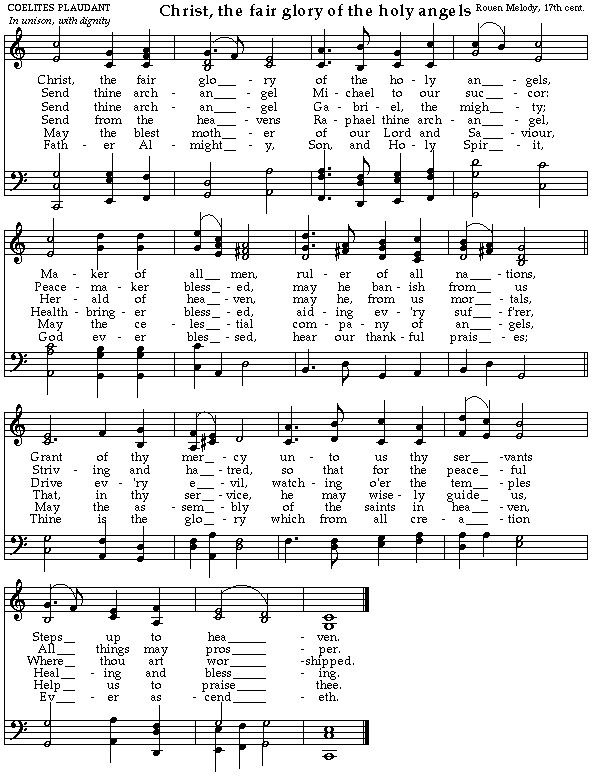
On the Feast of Michael and all Angels, popularly called Michaelmas, we give thanks for the many ways in which God's loving care watches over us, both directly and indirectly, and we are reminded that the richness and variety of God's creation far exceeds our knowledge of it.

The Holy Scriptures often speak of created intelligences other than humans who worship God in heaven and act as His messengers and agents on earth. We are not told much about them, and it is not clear how much of what we are told is figurative. Jesus speaks of them as rejoicing over penitent sinners (Lk 15:10). Elsewhere, in a statement that has been variously understood (Mt 18:10), He warns against misleading a child, because their angels behold the face of God. (Acts 12:15 may refer to a related idea.)

In the Hebrew Scriptures, it is occasionally reported that someone saw a man who spoke to him with authority, and who he then realized was no mere man, but a messenger of God. Thus we have a belief in super-human rational created beings, either resembling men in appearance or taking human appearance when they are to communicate with us. They are referred to as "messengers of God," or simply as "messengers." The word for a messenger in Hebrew is MALACH, in Greek, ANGELOS, from which we get our word "angel" [ Digression: ANGELION means "message, news" and EUANGELION means "good news = goodspell = gospel," from which we get our word "evangelist" used to mean a preacher of the Good News of salvation, and, more narrowly, one of the four Gospel-writers: Matthew, Mark, Luke, and John.]

By the time of Christ, Jewish popular belief included many specifics about angels, with names for many of them. There were thought to be four archangels, named Michael, Gabriel, Raphael, and Uriel. An alternative tradition has seven archangels (see Tobit 12:15 and 1 Enoch 20). Sometimes each archangel is associated with one of the seven planets of the Ptolemaic system (the moon, Mercury, Venus, the Sun, Mars, Jupiter, Saturn). Michael is associated with Saturn and Uriel with the Sun. The other pairings I forget, but I believe that you will find a list in the long narrative poem called "The Golden Legend," by Henry Wadsworth Longfellow. (I believe that a pairing is also offered in the opening chapters of the Proof of The Apostolic Preaching, by Irenaeus of Lyons, but I have not the work at hand.)

Michael (the name means "Who is like God?") is said to be the captain of the heavenly armies. He is mentioned in the Scriptures in Daniel 10:13,31; 12:1 (where he is said to be the prince of the people of Israel); in Jude 9 (where he is said to have disputed with the devil about the body of Moses); and in Revelation 12:7 (where he is said to have led the heavenly armies against those of the great dragon). In iconography, he is generally pictured in full armor, carrying a lance, and with his foot on the neck of a dragon. Oftentimes, his lance pierces the mouth of the serpent, as this demonstrates the power of truth to conquer the Father of Lies. (Pictures of the Martyr George are often similar, but only Michael has wings.)

Gabriel (the name means "God is my champion") is thought of as the special bearer of messages from God to men. He appears in Daniel 8:16; 9:21 as an explainer of some of Daniel's visions. According to the first chapter of Luke, he announced the forthcoming births of John the Baptist and of our Lord to Zachariah and the Virgin Mary respectively.

Raphael (the name means "God heals") is mentioned in the Apocrypha, in the book of Tobit, where, disguised as a man, he accompanies the young man Tobias on a quest, enables him to accomplish it, and gives him a remedy for the blindness of his aged father.

Uriel (the name means "God is my light" -- compare with "Uriah", which means "the LORD is my light") is mentioned in 4 Esdras.

It is thought by many scholars that the seven lamps of Revelation 4:5 are an image suggested by (among many other things) the idea of seven archangels.

What is the value to us of remembering the Holy Angels? Well, since they appear to excel us in both knowledge and power, they remind us that, even among created things, we humans are not the top of the heap. Since it is the common belief that demons are angels who have chosen to disobey God and to be His enemies rather than His willing servants, they remind us that the higher we are the lower we can fall. The greater our natural gifts and talents, the greater the damage if we turn them to bad ends. The more we have been given, the more will be expected of us. And, in the picture of God sending His angels to help and defend us, we are reminded that apparently God, instead of doing good things directly, often prefers to do them through His willing servants, enabling those who have accepted His love to show their love for one another.


Coelites Plaudant - 5 verses, C


Found at bee mp3 search engine

Tuesday, September 14, 2010

Litany in Honor of the Holy Cross

There's no better way to start off this day than with the greatest processional / recessional of all time, Lift High the Cross!
Lift High the Cross


Found at bee mp3 search engine

Readings for the Feast of the Holy Cross are found here.
Lord, have mercy.
Christ, have mercy.
Lord, have mercy.

Christ, hear us.
Christ, graciously hear us.
God, the Father of Heaven,
have mercy on us.
God the Son, Redeemer of the world,
have mercy on us.
God, the Holy Spirit,
have mercy on us.
Holy Trinity, One God,
have mercy on us.

The word of the Cross is folly to those who are perishing,
but to us who are being saved it is the power of God.

God forbid that I should glory save in the Cross of our Lord Jesus Christ,
by which the world has been crucified to me, and I to the world.

Reflection: Jesus has many who love His Kingdom in Heaven, but few who bear His Cross. He has many who desire comfort, but few who desire suffering. He finds many to share His feast, but few His fasting. All desire to rejoice with Him, but few are willing to suffer for His sake.

God forbid that I should glory save in the Cross of our Lord Jesus Christ,
by which the world has been crucified to me, and I to the world.

Reflection: Why do you fear to take up the Cross, which is the road to the Kingdom? In the Cross is salvation and life, protection against our enemies, infusion of Heavenly sweetness; in the Cross is strength of mind,joy of spirit, excellence of virtue, perfection of holiness. There is no salvation of soul, nor hope of eternal life, save in the Cross.

God forbid that I should glory save in the Cross of our Lord Jesus Christ,
by which the world has been crucified to me, and I to the world.

Reflection: Take up the Cross, therefore, and follow Jesus, and go forward into eternal life. Christ has gone before you, bearing His Cross;He died for you on the Cross, that you also may bear your cross,and desire to die on the Cross with Him. For if you die with Him,you will also live with Him. And if you share His sufferings, you will also share His glory.

God forbid that I should glory save in the Cross of our Lord Jesus Christ,
by which the world has been crucified to me, and I to the world.

Reflection: See how in the Cross all things consist, and in dying on it all things depend. There is no other way to life and to true inner peace, than the way of the Cross.Go where you will, seek what you will; you will find no higher way above nor safer way below than the road of the Holy Cross.

God forbid that I should glory save in the Cross of our Lord Jesus Christ,
by which the world has been crucified to me, and I to the world.

Reflection: The Cross always stands ready, and everywhere awaits you. You cannot escape it, wherever you flee; for wherever you go,you bear yourself, and always find yourself. Look up or down, without you or within, and everywhere you will find the Cross. And everywhere you must have patience, if you wish to attain inner peace, and win an eternal crown.

God forbid that I should glory save in the Cross of our Lord Jesus Christ,
by which the world has been crucified to me, and I to the world.

Lamb of God, Who take away the sins of the world,
spare us, O Lord!.
Lamb of God, Who take away the sins of the world,
graciously hear us, O Lord!
Lamb of God, Who take away the sins of the world,
have mercy on us.
Let us pray.
Lord Jesus Christ, strengthen us to follow Thee not only to the Breaking of Bread but also to the drinking of the Cup of Thy Passion. Help us to love Thee for Thine own sake and not for the sake of comfort for ourselves. Make us worthy to suffer for Thy name, Jesus, our Crucified and Risen Lord and Savior, now and forever. Amen.


If you haven't taught your children to remember their salvation using the sign of the cross (a duty Martin Luther put especially on fathers), why not today? For further reflection, I recommend ECatBedside's reflection piece.

Saturday, September 11, 2010

Paphnutius the Confessor

St. Paphnutius was an Egyptian bishop, of a city in the Upper Thebaid in the early fourth century, and one of the most interesting members of the Council of Nicæa (325). He suffered mutilation of the left knee (was hamstrung) and the loss of his right eye for the Faith under the Emperor Maximinus (308-13), and was subsequently condemned to the mines. At Nicæa he was greatly honoured by Constantine the Great, who, according to Socrates (Church History I.11), used often to send for the good old confessor and kiss the place whence the eye had been torn out.

He took a prominent, perhaps a decisive, part in the debate at the First Œcumenical Council on the subject of the celibacy of the clergy. It seems that most of the bishops present were disposed to follow the precedent of the Council of Elvira (can. xxxiii) prohibiting conjugal relations to those bishops, priests, deacons, and, according to Sozomen, sub-deacons, who were married before ordination. Paphnutius earnestly entreated his fellow-bishops not to impose this obligation on the orders of the clergy concerned. He proposed, in accordance "with the ancient tradition of the Church", that only those who were celibates at the time of ordination should continue to observe continence, but, on the other hand, that "none should be separated from her, to whom, while yet unordained, he had been united". The great veneration in which he was held, and the well known fact that he had himself observed the strictest chastity all his life, gave weight to his proposal, which was unanimously adopted. The council left it to the discretion of the married clergy to continue or discontinue their marital relations. Paphnutius was present at the Synod of Tyre (335) with St. Athanasius.

See more at Wikipedia.

Monday, August 30, 2010

Remembering Bp. Grafton

Bp. Charles G. Grafton was a lion of the faith, an ecumenist, and a mission-building bishop. He was a notable figure in early American Anglo-Catholicism (a turn toward the pre-Reformation faith that lived in England from 600-1400), leaving a serious body of works in letters and addresses.

He was the second Bishop of the Diocese of Fond du Lac. Prior to his election as bishop, Grafton was Rector of Church of the Advent in Boston.

Grafton was consecrated on December 15, 1875 at St. Paul's Cathedral, Fond du Lac by William E. McLaren of Chicago, Alexander Burgess of Quincy, and George F. Seymour of Springfield. Grafton founded the Anglican religious order Sisterhood of the Holy Nativity and was a founding member of the Society of St. John the Evangelist.

He is forever memorialized in a tune bearing his name which has been set to numerous hymns. However, I believe the most poignant is to "Sing my ton" the words of which are reproduced alone. Use this as your office hymn, or as thanksgiving for receiving the precious gift of the Lord's most precious body and blood in the Holy Communion.

Clyde McLennan - Now my tongue the mystery telling .mp3
Found at bee mp3 search engine

Readings:

Preface of a Saint (1)

PRAYER

Loving God, who didst call Charles Chapman Grafton to be a bishop in thy Church, endowing him with a burning zeal for souls: Grant that, following his example, we may ever live for the extension of thy kingdom, that thy glory may be the chief end of our lives, thy will the law of our conduct, thy love the motive of our actions, and Christ’s life the model and mold of our own; through the same Jesus Christ, who livest and reignest with thee and the Holy Spirit, one God, throughout all ages. Amen.

Tuesday, August 24, 2010

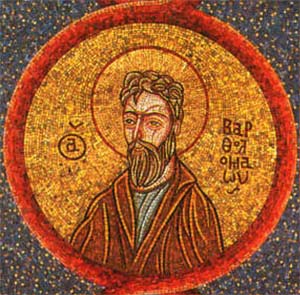
Feast of St. Bartholomew, Apostle

The name "Bartholomew" appears in the New Testament only on lists of the names of the twelve apostles. This list normally is given as six pairs, and the third pair in each of the Synoptics is "Philip and Bartholomew" (M 10:3; P 3:18; L 6:14; but A 1:15).


John gives no list of the Twelve, but refers to more of them individually than the Synoptists. He does not name Bartholomew, but early in his account (John 1:43-50) he tells of the call to discipleship of a Nathaniel who is often supposed to be the same person. The reasoning is as follows: John's Nathanael is introduced as one of the earliest followers of Jesus, and in terms which suggest that he became one of the Twelve. He is clearly not the same as Peter, Andrew, James, John, Philip, Thomas, Judas Iscariot, Judas (not Iscariot, also called Lebbaeus or Thaddeus), all of whom John names separately. He is not Matthew, whose call is described differently (M 9:9). This leaves Bartholomew, James the son of Alpheus, and Simon Zelotes. Of these, Bartholomew is the leading candidate for two reasons:

(1) "Bar-tholomew" is a patronymic, meaning "son of Tolmai (or Talmai)." It is therefore likely that he had another name. (A historical novel which may not be well researched informs me that a first-century Jew would be likely to use the patronymic instead of the forename as a mark of respect in speaking to a significantly older Jew.) "Nathanael son of Tolmai" seems more likely than "Nathanael also called James (or Simon)."
(2) Nathanael is introduced in John's narrative as a friend of Philip. Since Bartholomew is paired with Philip on three of our four lists of Apostles, it seems likely that they were associated.

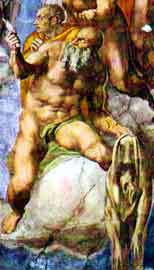
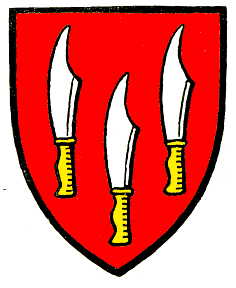
We have no certain information about Bartholomew's later life. Some writers, including the historian Eusebius of Caesarea (now Har Qesari, 32:30 N 34:54 E, near Sedot Yam), say that he preached in India. The majority tradition, with varying details, is that Bartholomew preached in Armenia, and was finally skinned alive and beheaded to Albanus or Albanopolis (now Derbent, 42:03 N 48:18 E) on the Caspian Sea. His emblem in art is a flaying knife. The flayed Bartholomew can be seen in Michelangelo's Sistine painting of the Last Judgement. He is holding his skin. The face on the skin is generally considered to be a self-portrait of Michelangelo.

Readings:

Psalm 91 or 91:1-4
Deuteronomy 18:15-18
1 Corinthians 4:9-15
Luke 22:24-30

Preface of Apostles

PRAYER (traditional language)

Almighty and everlasting God, who didst give to thine apostle Bartholomew grace truly to believe and to preach thy Word: Grant that thy Church may love what he believed and preach what he taught; through Jesus Christ our Lord, who liveth and reigneth with thee and the Holy Ghost, one God for ever and ever.

PRAYER (contemporary language)
Almighty and everlasting God, who gave to your apostle Bartholomew grace truly to believe and to preach your Word: Grant that your Church may love what he believed and preach what he taught; through Jesus Christ our Lord, who lives and reigns with you and the Holy Spirit, one God for ever and ever.

Sunday, August 15, 2010

There's Something About Mary

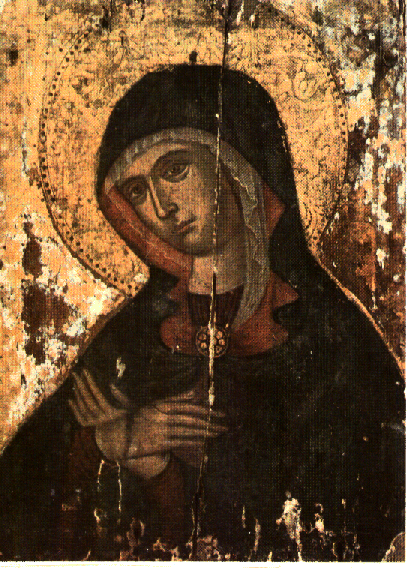
I’d like to explore some of the history of this Feast day of August 15th, which the calendar of lesser feasts and fasts calls the feast of Saint Mary the Virgin. The lesser feasts and fasts of the Church of England calls it the feast of the blessed Virgin Mary. The Anglican Church of Canada calls it the Falling Asleep of the Blessed Virgin Mary. The Lutherans call it the feast of Mary, mother of our Lord. The Orthodox Church calls it the Dormition of Mary, and the Romans call it The Feast of the Assumption of the BVM.

However, this feast was thrown off the liturgical calendar of the Church of England at the time of the Reformation. Was it because the Church of England didn’t like to celebrate the feast days of Saints? Not at all. If you look in the Book of Common Prayer of 1662 you see feasts for all of the biblical Saints, including red letter feast days for Mary—there are the feasts of the Purification of the Virgin Mary and Annunciation of the Blessed Virgin Mary—again as red letter feasts with their own appointed collects and lessons. In the list of lesser feasts of the 1662 Prayer Book there is also the feast of Conception of the Virgin Mary.

However, the primary or principle pre-reformation feast of the Virgin Mary was pointedly omitted from both the list of red letter primary feasts and black letter lesser feasts. Why is this?

Well, we must consider that during the time of the Reformation there were many abuses related to the saints—excessive devotion to specific saints was one of those abuses. Indeed, one could call it the cult of the saints. Chief among those individuals around whom cults had developed was the Virgin Mary. There had arisen so many specific and esoteric beliefs about Mary by the late middle ages that the theological study of Mary herself had developed—Mariology, as we now know it.

The Church of England attempted to keep a middle path between ignoring the feast days of the saints altogether and keeping them as they had been kept before the Reformation. The primary calendar omits all but the Biblical saints, and the list of lesser feasts and fasts kept only the feast days of the saints of the undivided Church.—Saint Cyprian, Saint Augustine, etc. While it kept the Biblical feasts of Mary, her primary feast was set aside, because at the time it was not simply the Feast of Saint Mary the Virgin, it was the Feast of the Assumption of the Virgin Mary—which means, of course, that she was assumed bodily into heaven. This belief had arisen around the 5th or 6th century and was based upon fanciful and apocryphal writings from the 4th century. The belief in the Assumption became accepted teaching in the 7th century Eastern Church. As the Roman Catholic historian Eatmon Duffy points out, “there is, clearly, no historical evidence whatever for it.”

Since this belief had no scriptural warrant the feast bearing the name of the Assumption was—rightly I believe—done away with in the official calendar of the Church of England. As I said, this does not mean that Anglicanism had forgotten the saints of the Church, nor did it mean that it had forgotten one of the primary saints of the New Testament. The goal of the new red letter calendar of Saints of the Book of Common Prayer was to make their celebration Christocentric in nature—the black letter lesser feasts and fasts pointed to the life of the ancient Church. The goal of the Saints was to point to Christ, and keeping the feast of the Assumption made this rather difficult , since it was centered around a nonbiblical and ahistorical event, and required numerous theological explanations and justifications.

When this once primary feast of Mary was reintroduced as a lesser feasts in America, Scotland, England, and Canada, mention of the Assumption was omitted, and now it was simply the feast of the BVM, Saint Mary the Virgin, or in its strongest form the “Falling Asleep of the Blessed Virgin Mary” (which is also the Eastern Orthodox title for the Feast). Now we have a feast of Mary that can celebrate the entirety of her life in relation to Christ, rather than celebrating an apocryphal event. This reminds one of the fact that in Orthodox iconography Mary is always to be presented holding the Christ Child, never alone (as she often is in the West), for her primary theological importance is that she was Theotokos, which is most often translated as Mother of God, but this manner of presenting the Greek is a little misleading. In English this makes it sound as though the emphasis is on the Mother. A more literal translation would be “she who gave birth to Him who was God”—and here the emphasis is on the deity of the child, not the motherhood of Mary. However, the very mention of a human mother implies the humanity of the Son, even after the divinity of the Son has been expressed and emphasized. We have here the very mystery of the Incarnation and are reminded of what Saint Paul has to say of the Person of Jesus as concerns his origin: “when the time had fully come, God sent forth his Son, born of woman, born under the law, to redeem those who were under the law, so that we might receive adoption as sons. And because you are sons, God has sent the Spirit of his Son into our hearts, crying, "Abba! Father!" So through God you are no longer a slave but a son, and if a son then an heir.”

Paul focuses on Christ’s fulfilling of the law, his humanity in conformity to his divinity to fulfill what we could fulfill not due to our sinful natures. Indeed, Paul does not even mention Mary’s name. But Mary is at the beginning of the historical drama of the Incarnation that Paul preached. In the liturgical life of the Church she appears most prominently at Christmastide, in statuary form as part of nativity displays, without prejudice in the homes of Christians of all backgrounds. The feast of Saint Mary, as well as the other Prayer Book feasts of Mary, allow us to dwell further on the biblical events surrounding this mystery from Mary’s perspective and examine what we can apply from her experience and example, to our lives.

In the gospel lesson for the feast we hear Mary rejoice in the part she will play in God’s plan of salvation. And Mary said, "My soul magnifies the Lord, and my spirit rejoices in God my Savior, for he has regarded the low estate of his handmaiden. For behold, henceforth all generations will call me blessed; for he who is mighty has done great things for me, and holy is his name. And his mercy is on those who fear him from generation to generation. He has shown strength with his arm, he has scattered the proud in the imagination of their hearts, he has put down the mighty from their thrones, and exalted those of low degree; he has filled the hungry with good things, and the rich he has sent empty away. He has helped his servant Israel, in remembrance of his mercy, as he spoke to our fathers, to Abraham and to his posterity for ever."

Her soul magnifies God. Her spirit rejoices in Her savoir. This song of praise echoes Luke’s Gospel from just a few verses earlier where Mary tells the angel Gabriel:
"Behold, I am the handmaid of the Lord; let it be to me according to your word."
And Elizabeth’s words to Mary: "Blessed are you among women, and blessed is the fruit of your womb! And why is this granted me, that the mother of my Lord should come to me? For behold, when the voice of your greeting came to my ears, the babe in my womb leaped for joy. And blessed is she who believed that there would be a fulfilment of what was spoken to her from the Lord."

She hears God’s word. She counts herself blessed to be chosen by God. She responds to God’s word obediently. Luke tells us that Mary pondered all these wonderful and strange events in her heart, but it does not tell us that she fully comprehended these events. Indeed, Luke tells us that Mary and Joseph did not understand what Jesus meant when they found him in the temple and he told them Did you not know that I must be in my Father's house?" Mary’s reaction can teach us about our own reactions to Christ ‘s role and work in our lives. Sometimes we won’t understand. Sometimes we have to wait and see. As Jesus grew in wisdom and in stature there were still times when Mary and Jesus’ brothers, in their inability to comprehend His work, sought after Him to bring Him home. Mark’s Gospel tells us that Jesus’ family thought He was crazy and attempted to seize Him. All we can do is wonder what Mary thought. We know that Mary knew the Jesus’ true origins, but we cannot know what she thought of the path His ministry had taken. Even if she knew He was the Messiah, like so many of Jesus’ disciples she may have misunderstood His actions.

However, even if Mary (and many of the disciples) didn’t fully understand the work of her Son, she was present in His earthly life until the end. John’s Gospel and Mark’s Gospel attest to her continued presence. We find her at the foot of the Cross. Ultimately, we find her as well at the founding of the Church in the Book of Acts. “All these with one accord devoted themselves to prayer, together with the women and Mary the mother of Jesus, and with his brothers.”

While we cannot say that Mary was assumed into Heaven, or that she was perfect in all of her actions, we can say that she was blessed amongst women, blessed for all generations, a woman who rejoiced in the knowledge that she needed a savior and that in her God she had a savior. We can say that she followed her Son her entire life, saw her own flesh and blood suffer and die a painful death upon the cross. . .and still find her in the Upper Room, rejoicing once again in the knowledge of her own salvation through Jesus Christ, fully God and fully man, her Son and our Lord. So, in Mary’s life we see the grace of God, reliance upon that grace, obedience to the will of God, and persistence in her faith through times of doubt, inability to comprehend, and probably fear. We see ultimate persistence. Let us pray that we too will be filled with grace, conformed to the will of God, and persist to the end in the Christian life that is laid before us.

Saturday, July 31, 2010

Feast of St. Peter's Chains (Lammas)


Please note that some Anglican Kalendars commemorate St. Joseph of Arimathaea on this day.

Collect

O GOD, who didst deliver thy holy Apostle Saint Peter from his bonds and suffer him to depart unhurt : vouchsafe, we pray thee ; to deliver us from the bonds of our sins, and of thy mercy preserve us from all evil. Through Jesus Christ, thy Son our Lord, who livest and reignest with thee, in the unity of the Holy Ghost, ever one God, world without end. Amen.

Hymn. Petrus beatus catenarum.

RIGHT wondrously set free, see, Peter freedom gains,
And at the Lord's command casts off his iron chains;
As shepherd and as guide he shews to life the way,
And from his Master's sheep drives guileful wolves away.

Now to the Trinity eternal glory sing,
All honour, virtue, might, and hymns of gladness bring.
He rules the universe in wondrous Unity,
And shall, through all the days of vast eternity. Amen.

For the legend

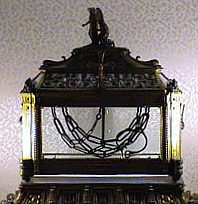
Veneration of St. Peter's ChainsTHE Apostle Peter was put in prison for the Name of the Lord Jesus, and bound with Chains ; and that not once only, nor in one place, but several times, and in divers places. In the Acts of the Apostles we read how, immediately after Pentecost, he and the Apostle John went up to the temple together ; and there, at the temple gate, he healed the lame man ; and afterwards, whilst he was speaking to the people, he and John were taken by the Jewish priests, out of envy, and put in hold, that is, in Chains, unto the next day. And when they were brought forth, on the morrow, Peter shewed such constancy in his witness of Christ, along with John, that the rulers themselves could not but admire the fearless boldness of these Apostles whom they esteemed as unlearned and ignorant men. And the faith of all those who heard of this matter was in such wise strengthened by the apostolic witness, and Peter's Chains, that the number of believers increased to five thousand.

IT was not so long a time after, when all kind of diseases were healed by the shadow of Peter only, passing by, that he was taken again, and with the other Apostles was put into the common prison, at the command of the high priests and Sadducees, and thus a second time he was bound with Chains. But the Angel of the Lord by night opened the prison doors and sent the Apostles forth to preach Christ, despite the prohibition of men. Whereupon Peter and the other Apostles were apprehended, and brought before the Council, and condemned to be beaten, in an attempt to make them obey men rather than God. The third time whereof we have record of Peter's Chains is after the death of James, when Herod perceived that the murder of this Apostle was not displeasing to the Jews, and so proceeded to take Peter also, and had him bound with two Chains, and kept in prison under the ward of four quaternions of soldiers. Wherefrom he was again wondrously delivered by an Angel.

LASTLY, when he suffered martyrdom at Rome, he was kept in the Mamertine prison, and is said to have been bound in Chains by the command of Nero, which Chains have been held in honour by the Church from the first ages. Further, Arator, Subdeacon of the Roman Church in the sixth century, wrote that the Chains wherewith Peter was bound at Jerusalem, or certainly some of them, were preserved at Rome in his own time, and consequently the veneration of Peter's Chains greatly increased ; especially when, as we learn from other records of the Church of Rome, a basilica was built by the younger Eudoxia, wife of Valentinian III, on the Esquiline Hill, under the name of Saint Peter in Chains. This temple, or a re-building of it, was dedicated on August 1st, whence the day was placed in the Kalendar as the Feast of Saint Peter's Chains, afterwards called in England Lammas Day, from the custom of offering loaves of bread made from the first-gathered grain of the year, in thanksgiving from the beginning of the harvest. And, because of his Chains, this holy Apostle is often invoked for those in bondage.

From the Anglican Breviary

Herod Agrippa, the grandson of Herod the Great and king of the Jews, grew wroth against the Church of Christ, and slew James, the brother of John the Evangelist. Seeing that this pleased the Jews, he took Peter also into custody and locked him up in prison, intending to keep him there until after the feast of the Passover, so that he could win the favour of the people by presenting him to them as a victim. But the Apostle was saved when he was miraculously set free by an Angel (Acts 12:1-19). The Chains wherewith the Apostle was bound received from his most sacred body the grace of sanctification and healing, which is bestowed upon the faithful who draw nigh with faith.

That such sacred treasures work wonders and many healings is witnessed by the divine Scripture, where it speaks concerning Paul, saying that the Christians in Ephesus had such reverence for him, that his handkerchiefs and aprons, taken up with much reverence, healed the sick of their maladies: "So that from his body were brought unto the sick handkerchiefs or aprons, and the diseases departed from them, and the evil spirits went out of them" (Acts 19:12). But not only the Apostles' clothing (which certainly touched the bodies of the sick), but even their shadow alone performed healings. On beholding this, people put their sick on stretchers and beds and brought them out into the streets that, when Peter passed by, his shadow "might overshadow some of them" (Acts 5:15). From this the Orthodox Catholic Church has learned to show reverence and piety not only to the relics of their bodies, but also in the clothing of God's Saints.

- From the Great Synaxarion by Holy Transfiguration Monastery.

For three centuries the Chains were kept in Jerusalem, and those afflicted with illness and approached them with faith received healing. Patriarch Juvenal presented the Chains to Eudokia, wife of the emperor Theodosius the Younger, and she in turn transferred them from Jerusalem to Constantinople in either the year 437 or 439.

Eudokia sent one Chain to Rome to her daughter Eudokia (the wife of Valentinian), who built a church on the Esquiline Hill dedicated to the Apostle Peter and placed the Chains in it. There were other Chains in Rome, such as that which had bound the saint during his nine month imprisonment in the Mamertine Prison near the Forum, with which the Apostle Peter was shackled before his martyrdom under the Emperor Nero. These were also placed in the church. It is said that when the pope compared the two Chains, they miraculously fused together into one unbreakable series of links. Because of this miracle, Empress Eudokia built the Basilica of Saint Peter in Chains (S. Peter ad Vincula or San Pietro in Vincoli), and dedicated it to the apostle in the year 442. The relic is now kept in a golden urn beneath the high altar, close to the famous statue of Michelangelo's Moses.

The basilica has undergone several restorations and rebuildings, including a restoration by Pope Adrian I, a rebuilding by Pope Sixtus IV and another by Pope Julius II. There was also a renovation in 1875. Some modernizations were made at that time.

Michelangelo's Moses, which dates from 1515, is the most notable piece of artwork in the basilica. Originally intended as part of a 40-statue funeral monument for Pope Julius II, Moses became the Pope's funeral monument and tomb in his family's church.

Further, Arator, Subdeacon of the Roman Church in the sixth century, wrote that the Chains wherewith Peter was bound at Jerusalem, or certainly some of them, were preserved at Rome in his own time, and consequently the veneration of Peter's Chains greatly increased; especially when, as we learn from other records of the Church of Rome, a basilica was built by the younger Eudokia, wife of Valentinian III, on the Esquiline Hill, under the name of Saint Peter in Chains. This temple, or a re-building of it, was dedicated on August 1st, whence the day was placed in the Roman Calendar as the Feast of Saint Peter's Chains, afterwards called in England Lammas (lit. loaf-mass) Day, from the custom of offering loaves of bread made from the first-gathered grain of the year, in thanksgiving from the beginning of the harvest. And, because of his Chains, this holy Apostle is often invoked for those in bondage.

When Constantine the Great became emperor of Rome and ended the persecutions against the Church, the Christians of Rome gathered the relics of the Apostle Peter together with the Chains that held him in prison in Rome, and a temple was dedicated to them by the emperor. The Chains were greatly venerated by the faithful, for just as the shadow of the apostle worked miracles so also did the Chains that held him. The relics of the Apostle Peter were placed on a throne in a hidden area of the temple to prevent its theft, and this area was only opened three times a year for Christians to go and venerate the apostle seated on his throne.