Monday, November 30, 2009

Even Atheists Understand

A lot of people are talking trash about the New Atheism (and in some cases, rightly so). But I want to address the oldest atheism. The oldest atheism is the atheism that God's chosen people (under the old covenant, mostly national Israel; under the new covenant, the baptized) exercise when they disbelieve the gospel.

“The world does not consist of 100 per cent Christians and 100 per cent non-Christians. There are people (a great many of them) who are slowly ceasing to be Christians but who still call themselves by that name; some of them are clergymen. There are other people who are slowly becoming Christians though they do not yet call themselves so. There are people who do not accept the full Christian doctrine about Christ but who are so strongly attracted by Him that they are His in a much deeper sense than they themselves understand. There are people in other religions who are being led by God’s secret influence to concentrate on those parts of their religion which are in agreement with Christianity, and who thus belong to Christ without knowing it...”
C.S. Lewis, Mere Christianity
Ch. 10, “Nice People or New Men.”
How do you know if your a Christian Atheist or if you're a Christian? Let me pose some questions that can guide us on the path:
Is the law written in my heart?
Do I love God with all my heart, soul, mind and strength?
Do I love my neighbor as myself?
Do I live by the Spirit?
Do I love the brothers?
Do I kill sin?
Do I repent?
Do I believe?
Do I die to self?
Do I follow Jesus?
Do I love Jesus more than the world?
  • More than family and loved ones?
  • More than life itself?
Is Jesus my treasure?
Do I delight in him above all else?
Do I obey his commandments?
Do I treat suffering people as if they were Christ himself?
Is my faith working through love?
Do I forgive others as God forgives me?
  • Am I aware enough of God's forgiveness that I can forgive myself & others?
Am I increasing in holiness?

Feast of St. Andrew

Readings:

Psalm 19 or 19:1-6
Deuteronomy 30:11-14
Romans 10:8b-18
Matthew 4:18-22

Preface of Apostles

Collect: Almighty God, who gave such grace to your apostle Andrew that he readily obeyed the call of your Son Jesus Christ, and brought his brother with him: Give unto us, who are called by your Word, grace to follow him without delay, and to bring those near to us into his gracious presence; who lives and reigns with you and the Holy Spirit, one God, now and for ever.

Icon of St. AndrewMost references to Andrew in the New Testament simply include him on a list of the Twelve Apostles, or group him with his brother, Simon Peter. But he appears acting as an individual three times in the Gospel of John. When a number of Greeks (perhaps simply Greek-speaking Jews) wish to speak with Jesus, they approach Philip, who tells Andrew, and the two of them tell Jesus (Jn 12:20-22). (It may be relevant here that both "Philip" and "Andrew" are Greek names.) Before Jesus feeds the Five Thousand, it is Andrew who says, "Here is a lad with five barley loaves and two fish." (Jn 6:8f) And the first two disciples whom John reports as attaching themselves to Jesus (Jn 1:35-42) are Andrew and another disciple (whom John does not name, but who is commonly supposed to be John himself -- John never mentions himself by name, a widespread literary convention). Having met Jesus, Andrew then finds his brother Simon and brings him to Jesus. Thus, on each occasion when he is mentioned as an individual, it is because he is instrumental in bringing others to meet the Saviour. In the Episcopal Church, the Fellowship of Saint Andrew is devoted to encouraging personal evangelism, and the bringing of one's friends and colleagues to a knowledge of the Gospel of Christ.

Just as Andrew was the first of the Apostles, so his feast is taken in the West to be the beginning of the Church Year. (Eastern Christians begin their Church Year on 1 September.) The First Sunday of Advent is defined to be the Sunday on or nearest his feast (although it could equivalently be defined as the fourth Sunday before Christmas Day).

Several centuries after the death of Andrew, some of his relics were brought by a missionary named Rule to Scotland, to a place then known as Fife, but now known as St. Andrew's, and best known as the site of a world-famous golf course and club. For this reason, Andrew is the patron of Scotland.

When the Emperor Constantine established the city of Byzantium, or Constantinople, as the new capital of the Roman Empire, replacing Rome, the bishop of Byzantium became very prominent. Five sees (bishoprics) came to be known as patriarchates: Rome, Alexandria, Antioch, Jerusalem, and Byzantium. Now, the congregation at Rome claimed the two most famous apostles, Peter and Paul, as founders. Antioch could also claim both Peter and Paul, on the explicit testimony of Scripture, and of course Jerusalem had all the apostles. Alexandria claimed that Mark, who had been Peter's "interpreter" and assistant, and had written down the Gospel of Mark on the basis of what he had heard from Peter, had after Peter's death gone to Alexandria and founded the church there. Byzantium was scorned by the other patriarchates as a new-comer, a church with the political prestige of being located at the capital of the Empire, but with no apostles in its history. Byzantium responded with the claim that its founder and first bishop had been Andrew the brother of Peter. They pointed out that Andrew had been the first of all the apostles to follow Jesus (John 1:40-41), and that he had brought his brother to Jesus. Andrew was thus, in the words of John Chrysostom, "the Peter before Peter." As Russia was Christianized by missionaries from Byzantium, Andrew became the patron not only of Byzantium but also of Russia.

Andrew is the national saint of Scotland (thus appreciated, even by Presbyterians! - Ed.). George (23 Apr) is the national saint of England, Patrick (17 Mar) of Ireland, and Dewi = David (1 Mar) of Wales. George, who was a soldier, is customarily pictured as a knight with a shield that bears a red cross on a white background. This design is therefore the national flag of England. It is said that Andrew was crucified on a Cross Saltire -- an 'X' -shaped cross. His symbol is a Cross Saltire, white on a blue background. This is accordingly the national flag of Scotland. A symbol of Patrick is a red cross saltire on a white background. The crosses of George and Andrew were combined to form the Union Jack, or flag of Great Britain, and later the cross of Patrick was added to form the present Union Jack. Wales does not appear as such (sorry!). Whether there is a design known as the cross of David, I have no idea.

by James Kiefer

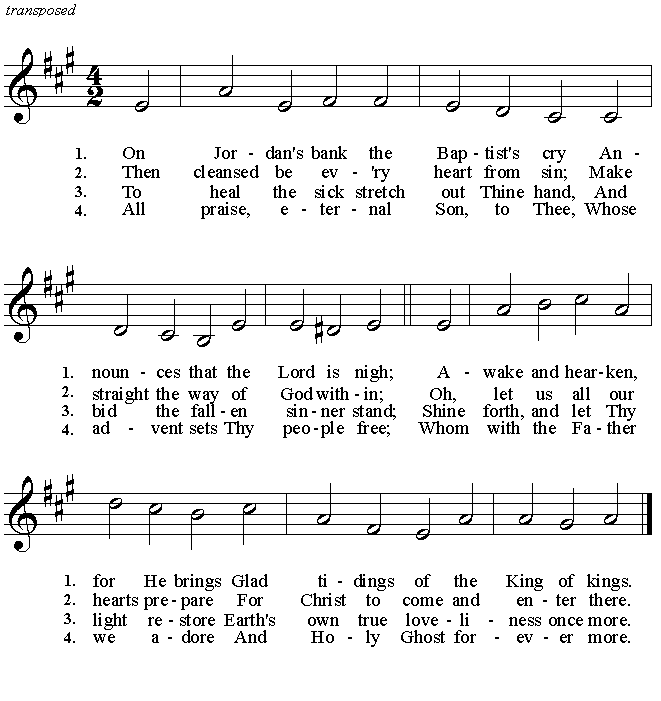
On Jordan's Banks

Clyde McLennan - On Jordan's bank


Found at bee mp3 search engine


Mark 1:4-9

Sunday, November 29, 2009

The Advent of Our God

Clyde McLennan - The advent of our God


Found at bee mp3 search engine

The advent of our God
Our prayers must now employ,
And we must meet Him on His road
With hymns of holy joy.

The everlasting Son
Incarnate deigns to be;
Himself a servant’s form puts on
To set His people free.

Daughter of Zion, rise
To meet thy lowly King,
Nor let thy faithless heart despise
The peace He comes to bring.

As Judge, on clouds of light,
He soon will come again,
And all His scattered saints unite
With Him in Heaven to reign.

Before the dawning day
Let sin’s dark deeds be gone;
The old man all be put away,
The new man all put on.

All glory to the Son
Who comes to set us free,
With Father, Spirit, ever One,
Through all eternity.

Isaiah 40:9-11

Wednesday, November 25, 2009

The Heart of Anglocatholic Worship

Taken from Fr. Chris' personal blog:

"You may take away from us, if you will, every external ceremony; you may take away altars, and super-altars, and lights, and incense, and vestments; you may take away, if you will, the eastward position; you may take away every possible ceremony; and you may command us to celebrate at the altar of God without any external symbolism whatsoever; you may give us the most barren of all observances, and we will submit to you. If this Church commands us to have no ceremonies, we will obey. But, gentlemen, the very moment any one says we shall not adore our Lord present in the Eucharist, then from a thousand hearts will come the answer, as of those bidden to go into exile, "Let me die in my own country and be buried by the grave of my father and my mother!" to adore Christ's person in His Sacrament, is the inalienable privilege of every Christian and Catholic heart. How we do it, the way we do it, the ceremonies which we do it, are utterly, utterly indifferent; the thing itself is what we plead for..."

James DeKoven, DD in a speech before General Convention, 1874

God With Us...are we with them?

Tomorrow is Thanksgiving Day. We have much to be thankful for, despite the economic downturn. The day after is "black Friday" - when stores hope to be put "back in the black" after a dismal retail season. But for some children, black Friday is just going to be another dark day.

I was struck by this meditation by Chuck Colson on the value of the Angel Tree program. St. Stephen Church has faithfully taken on at least one Angel Tree family. This year, we are stepping up and taking two families. There will be food to provide, clothes to warm them, and toys to brighten their lives.

Would you consider making a contribution to cover the costs of extending the love of Jesus to our Angel Tree families? You can designate it through your tithes check. Alternately, if you'd like to personally purchase for a need (perhaps while you're shopping on Friday), contact Pat Miles. She has the sizes for the children and can coordinate other gift-givers.

Thank you so much!

Us With Them?

Chuck ColsonToday I want to tell you about a young lad named Emmanuel. And then I’m going to ask you to help with an urgent need by showing a prisoner’s child that God truly is with us.
Listen Now | Download
I can’t sing the words of that familiar Advent song “O Come, O Come, Emmanuel” without remembering a young boy—a child of a prisoner.

Every year, Patty and I deliver Angel Tree Christmas gifts to the children of prisoners. And I’ll never forget one year in particular, when Patty and I drove into a housing project to deliver our gifts.

We saw broken windows and grim-faced gang members lounging in doorways. After parking our car, we found our way to an apartment and knocked on the door. A boy, about 9 years old, cautiously opened the door.

“Merry Christmas,” I said, holding out the presents. “These are from your Daddy.”

Immediately, the door swung wide open to let us in. The boy’s mother was on her way home from work, and as we waited for her, we saw that the apartment inside was a wreck. The furniture was torn, the stuffing falling out. A scraggly Christmas tree leaned up against the wall, bare of any presents.

When I asked the boy his name, he replied, “Emmanuel.”

“Emmanuel,” I said, “Do you know what your name means?” I opened my Bible and read from Matthew: “And they shall call him Emmanuel—which means ‘God with us.’”

Just then, his mother came to the door. Emmanuel threw his arms around her thighs, crying, “Mama, Mama, God is with us!”

In Emmanuel’s clear voice, I heard the message of Christmas afresh: that God is indeed with us always—and in a special way at Christmas, when He entered history through Jesus Christ.

I was particularly reminded that He came for the prisoner who turned His back on Him. He came for the mother who can’t make ends meet. And He came for the child who cries himself to sleep at night because he’s never known his daddy.

God is with us. And He has given us the rare chance to be with those who desperately need Him.

Each year, Angel Tree brings this message of hope to hundreds of thousands of children of inmates. Church volunteers deliver Christmas gifts—and the Gospel message—in the name of the incarcerated parent. Think what this means—not only to the children, but to the moms and dads in prison as well.

But this year we are facing an unprecedented crisis. Although churches have committed to delivering gifts to some 300,000 children, due to the slow economy and some other factors, there are 50,000 children as of today who remain unclaimed. They have no sponsors.

And so I’m doing something I’ve never done before. Please go to our website, AngelTree.org, as soon as you’ve heard this broadcast, and sponsor one child for a donation of $35.20—enough to send a gift, Gospel materials, and a message from mom or dad to that child. Or maybe you could take two or three, or more, as God leads you.

And you could ask your church to help as well. Maybe they can adopt a group of children in an area. The thing is, we must not fail. No child should be forgotten this Christmas.

God showed us that first Christmas that He is with those who have no hope. And we have the rare privilege of taking that message to these children. Sign up, please, at AngelTree.org today. Please, we need your help desperately.


Tuesday, November 24, 2009

Competitive Vulnerability

Crossposted from Fr. Chris' blog.

Novelist Sara Maitland coined the term “competitive vulnerability” to describe those who believe their pain must be bigger than that of others so that they achieve a moral high-ground or greater voice or more grievances to be redressed.

There's a problem here - especially for people that are working to be pastors: If all I'm looking for in your hurt is to see your bet and raise it, I'm looking at it the wrong way. Sadly, this is all too often the tactic taken in church disagreements.

Abraham Maslow once said, "If the only tool you have is a hammer, you tend to see every problem as a nail. " Mainline seminaries have sold out to the "oppression / patriarchy / issues" ticket, and are creating ordinands that are incapable of reflecting on ethical, theological, biblical, or political issues outside of that framework. And the people (parishioners & clergy) are poorer for it.