![]() |
| The Rev'd Dr. Percy Dearmer |
Gathering faithful Anglicans - evangelical Christians of orthodox and catholic faith - together for witness to the River City and throughout central Kentucky.
Wednesday, February 22, 2017
Historic and True Anglicanism
Friday, June 24, 2016
The Nativity of St. John the Baptist
Today is the Nativity of St. John the Baptist |
The Church celebrates only three birthdays: our Lord’s, our Lady’s, and St. John the Baptist’s. The other saints’ days are heavenly birthdays, when the saint died or was martyred and went to Heaven. John fulfills the prophecy of Malachi, “Behold, I send my messenger before thy face, which shall prepare thy way before thee.” (Malachi 3:1) John was a steward of the mysteries of God.
Every feast has a steward. Every large airplane, every passenger ship, has stewards and stewardesses. An umpire at a baseball game is a steward of the game. John was a steward of the mysteries of God. He was a watershed figure in the Bible. He is the crown of the Old Testament prophets, the last of the Old Testament watchmen, and the first of the New Testament witnesses, witnesses to Jesus. John the Baptist was like the best man at a wedding. Jesus is the Bridegroom, the Church is the Bride, and John the Baptist is the best man. He prepares the way for the Bridegroom, by preaching repentance, and a baptism of repentance.
The Benedictus we say in every Morning Prayer is the Song of Zechariah, John the Baptist’s father. Zechariah is married to Elisabeth, Mary’s cousin. They are far too old to have children, so John’s conception is extraordinary. As soon as he names his son John, Zechariah is filled with the Holy Spirit and blesses the God of Israel. He prophesies that John will go before the face of the Lord to prepare His ways. The name John means “gift of God.” John’s gift will be the dangerous work of being the Forerunner, the one who prepares the way, the ultimate recon mission. He grows up in the desert so he can hear God’s voice and be tough as nails. He eats what is there, locusts and wild honey, and he wears animal skins. He will be a trailblazer, a pioneer and the divine herald of the coming Messiah. The mighty salvation of the world has a forerunner.
John was a man of the desert. He called the shots as God instructed him, and called the best men of the day a “brood of vipers.” John is like a surgeon clearing a clogged heart valve or a pioneer hacking a road through the wilderness or a dentist drilling out a cavity. He is like a man with an air hammer breaking through old pavement, to prepare a new road surface. The hearts of men must be broken and prepared in repentance for the coming of the Anointed One. Not surprisingly, John ends up in prison, where Herod Antipas will eventually have him beheaded. Jesus will say of John that he is even more than a prophet. John fulfills the prophesy of Malachi, “Behold, I send my messenger before thy face…”
|
The Church’s vocation, like that of John the Baptist’s, is to point to Jesus. As John prepares to baptize Jesus he says of his cousin what we say at every Mass, “Behold, the Lamb of God, which taketh away the sin of the world.” (John 1: 29) The ministers of Christ are stewards of the mysteries of God, to prepare His way before Him. We may ask today whether there is a John the Baptist of our own times. It is entirely possible that few, if any, filled this role like Alexandr Solzhenitsyn, perhaps the greatest prophetic voice of the 20th century. Solzhenitsyn, after WWII, was interred in a gulag for ten years for a slight criticism of an army officer. In the gulag, he came to repentance and conversion. He realized that the dividing line between good and evil, right and wrong, light and darkness, ran right through his own heart. He realized that the race of man, and he himself, could not redeem breakdown and disintegration. “Behold the Lamb of God, which taketh away the sin of the world.” Solzhenitsyn put his trust in the incarnate Son of God, the Lamb who is the Shepherd. He went on, as a literary genius and now a Christian, to expose the central flaw of our times, for both East and West, made clear to us in the peasant proverb, “Men have forgotten God.” In his masterpiece, August 1914: the Red Wheel, he brings us all up short with the devastating revelation that the end of the Christian West took place in August of the year 1914, in a war inspired by the demons, in which traditional, conservative, believing Christians, all related to each other in their various royal families, would have at each other for four years of mass slaughter, and rip apart the consensus of the Christian West and tear apart beyond all recognition the cultural and social fabric put in place by centuries of Christian sacrifice. Solzhenitsyn sees the two world wars as one thirty year civil war of Europe tearing itself apart. World War I gave us communist Russia, and World War II gave us Communist China, huge segments of the human race spinning off into a new gnosticism which then devolved further into the gnostic feminism which has torn apart what was left. But Solzhenitsyn ministers to us in great works like his Harvard Commencement Address, in June, 1978, offering us a way forward in a new synthesis transcending materialism, in which Christian theology engages with physics, biology, chemistry, mathematics, and the social sciences, in a new dynamic, to create a new synthesis. This great Address is our agenda as believing Christians for the entire 21st century. And today there is a revolution taking place in physics, biology and chemistry, and in the social sciences too, for those brave enough to cast aside the pathetic burned out shackles of secular humanism, gnosticism and nihilism.
There are other great prophetic figures of the previous century, too many to name here. But we could cite, in the same breath as Solzhenitsyn, a contemporary of great stature. Archbishop Arthur Michael Ramsey writes that “It was in reaction from liberal theology that Karl Barth and his school uttered afresh the message of God’s otherness and sovereignty and His mighty act in the Resurrection, as the war of 1914-1918 was drawing to its close. The Resurrection was the central message of Barth; and he recalled Christians who minds were full of man’s religion, man’s experiences and man’s progress, to the Act of the living God which confronts a race helpless to save itself. Jesus Christ is Lord. This is the Gospel and the meaning of history…(Barth) stirred Christians in every land and tradition to face once more the transcendental and catastrophic themes of the New Testament.” (The Resurrection of Christ, p. 119)
Let us today thank God for St. John the Baptist and to those multitudes who, like Solzhenitsyn and Barth, follow in his footsteps as stewards of the mysteries of God, to prepare the way of the Lord, so that the “day-spring from on high” may visit us, and appear in our minds, our hearts and our service to one another.
“Almighty God, by whose providence thy servant John Baptist was wonderfully born, and sent to prepare the way of thy Son our Saviour by preaching repentance; Make us so to follow his doctrine and holy life, that we may truly repent according to his preaching; and after his example constantly speak the truth, boldly rebuke vice, and patiently suffer for the truth’s sake, through the same thy Son Jesus Christ our Lord. Amen.” (BCP p. 242)
|
Tuesday, February 21, 2012
Gingerbread Pancakes for Shrove Tuesday
GINGERBREAD PANCAKES
(inspired by Kerbey Lane in Austin, but it’s been so long since I’ve eaten there, I can’t verify the authenticity)
Cream together:
6 eggs
2/3 cup brown sugar
Add, then mix well:
1 cup buttermilk*
3/4 cup water
1/2 cup coffee (brewed)
2 tsp vanilla
In a seperate bowl, combine dry ingredients:
5 cups all-purpose flour
1 tsp baking powder
2 tsp baking soda
1/4 Tbs. cloves
2 Tbs. cinnamon
2 Tbs. ginger
1.5 Tbs. nutmeg
Add dry ingredients to wet, mixing gently. When combined, mix in:
1 stick of butter, melted
This makes about 7-8 thick, plate sized pancakes. SUPER thick. Cut back a tsp of baking soda or so if you prefer less cake-y pancakes.
* buttermilk is easy to make: 1 c. milk + 1 Tbs. lemon juice or vinegar, I let it stand for a half hour or so, but you could probably push it to even 5 or 10 minutes in a pinch.
Friday, January 28, 2011
Installation at Holy Apostles in Elizabethtown
10:00am – 11:30am
Holy Apostles Anglican Church
56 Public Square
Elizabethtown, KY
The Rt. Rev’d. John A. M. Guernsey, bishop of the Diocese of the Holy Spirit, will preach, celebrate the Eucharist, and install the Rev’d. Chris Larimer as rector of Holy Apostles Anglican Church. The service will begin at 10 AM. Holy Communion is available to all baptized Christians. Afterward, light refreshments will be served and there will be a meet-and-greet with the bishop.
Childcare will be available. Children are welcome in the service. Parking is available around the square and behind the church in Strawberry Alley.
For details, contact the church (270-769-1170) or the rector (frchris@holyapostlesky.org).
Visiting clergy are welcome to process (red stoles, please).
There's also an interview at the Western Kentucky Anglican's blog!
PS - I have it on good authority that Art Going, an AMiA church planter beginning work in Louisville, will be there. Come meet him, too!
Friday, December 17, 2010
War on Christmas?
Don't forget to check for updates on Anglican Christmas services in the greater central KY area.
Tuesday, December 14, 2010
Christmas is Coming
Christmas Eve
5:30 p.m., Family Service
8:00 p.m., Choral Prelude
8:30 p.m. Traditional Service
Christmas Day - no services
St. Luke's (Maysville, KY)
Christmas Eve 3:00p.m. on 12/24.
Christmas Day - no services
Friday, November 5, 2010
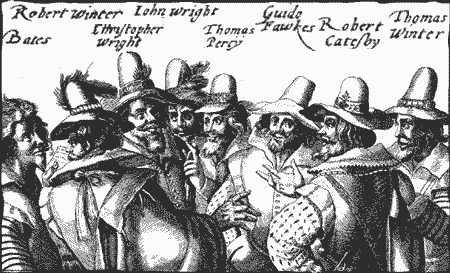
Happy Bonfire Day!
Happy Guy Fawkes Day, everybody!
-
- Remember, remember the Fifth of November,
- The Gunpowder Treason and Plot,
- I know of no reason
- Why the Gunpowder Treason
- Should ever be forgot.
- Guy Fawkes, Guy Fawkes, t'was his intent
- To blow up the King and Parli'ment.
- Three-score barrels of powder below
- To prove old England's overthrow;
- By God's providence he was catch'd
- With a dark lantern and burning match.
- Holla boys, Holla boys, let the bells ring.
- Holla boys, Holla boys, God save the King! (Queen)
Here's to 492 years of the Gospel recovered, and 404 years of the Gospel in England providentially defended!
Wednesday, October 13, 2010
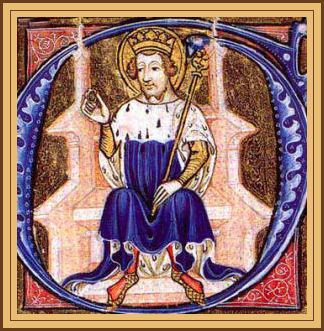
Translation of Edward the Confessor
Æthelred was followed by several Danish kings of England, during whose rule young Edward and his mother took refuge in Normandy. But the last Danish king named Edward as his successor, and he was crowned in 1042. Opinions on his success as a king vary. Some historians consider him weak and indecisive, and say that his reign paved the way for the Norman Conquest. Others say that his prudent management gave England more than twenty years of peace and prosperity, with freedom from foreign domination, at a time when powerful neighbors might well have dominated a less adroit ruler. He was diligent in public and private worship, generous to the poor, and accessible to subjects who sought redress of grievances.
While in exile, he had vowed to make a pilgrimage to Rome if his family fortunes mended. However, his council told him that it was not expedient for him to be so long out of the country. Accordingly, he spent his pilgrimage money instead on the relief of the poor and the building of the Collegiate Church of St Peter at Westminster, better known as Westminster Abbey, which stands today (rebuilt in the thirteenth century) as one of the great churches of England, burial place of her kings and others deemed worthy of special honor. He is buried there as well.
He died on 5 January 1066, leaving no offspring; and after his death, the throne was claimed by his wife's brother, Harold the Saxon, and by William, Duke of Normandy. William defeated and slew Harold at the Battle of Hastings (14 October 1066), and thereafter the kings and upper classes of England were Norman-French rather than Anglo-Saxon. Edward is remembered, not on the day of his death, but on the anniversary of the moving ("translation") of his corpse to a new tomb, a date which is also the anniversary of the eve of the Battle of Hastings, the end of Saxon England.
| Clyde McLennan - Round the Lord in glory seated .mp3 | ||
| | ||
| Found at bee mp3 search engine |
O God, who called your servant Edward to an an earthly throne That he might advance your heavenly kingdom, and gave him zeal for your Church and love for your people: Mercifully grant that we who commemorate him this day may be fruitful in good works, and attain to the glorious crown of your saints; through Jesus Christ our Lord, who lives and reigns with you and the Holy Spirit, one God, for ever and ever.
Wednesday, October 6, 2010
Ten Cheers for Tyndale
Let us render hearty thanks to God for these two servants. And let us take up their cause by reading the Scriptures for ourselves in "a language understanded of the people" and applying it to our lives.
COLLECT: Almighty God, you planted in the heart of your servants William Tyndale and Miles Coverdale a consuming passion to bring the Scriptures to people in their native tongue, and endowed them with the gift of powerful and graceful expression and with strength to persevere against all obstacles: Reveal to us your saving Word, as we read and study the Scriptures, and hear them calling us to repentance and life; through Jesus Christ our Lord, who lives and reigns with you and the Holy Spirit, one God, for ever and ever. Amen.
Below is an excellent video that gives an accessible visual rendering of the history of the English Bible.
Wednesday, September 22, 2010
Tuesday, August 31, 2010
Confessional Anglicanism is our Future
Some people allege that the Anglican Church in North America is hopelessly theologically muddled, a mere 20-year reset button on TEc, and an overly-diverse group that will fly apart as soon as the common threat of pansexualism is absent.
Archbishop Duncan says PHOOEY on that...we're in this together to confess Christ together, and our vision is still the GAFCON Jerusalem Statement.
Monday, August 30, 2010
Sermon for Proper17C
Sermon Proper17C Humble Hospitality, Fr Chris Larimer from Fr. Chris Larimer.
A sermon on Luke 14 & Hebrews 13, preached at Holy Apostles Anglican Church in Elizabethtown, KY.
Thursday, June 17, 2010
The Gospel in Galatians
In our study on Galatians, this is exactly what we're learning. The gospel is that Jesus essentially says, "Yo Teach...I got this one!" You can't possibly be good enough to earn favor with God. But you can turn a grateful heart to what He's done for you!
If you need to hear the gospel afresh, join us this Sunday at the Louisville Anglican Prayer Fellowship.
Sunday, June 13, 2010
Sermon Proper 6 Galatians 1:11-2:10
Sermon Galatians 2 LAPF - Fr. Chris Larimer from Fr. Chris Larimer on Vimeo.
This is the second of a series on Galatians that I'm be preaching before the Louisville Anglican Prayer Fellowship. The text is Galatians 1:11-2:10 (ESV). It also reflects on the diversity found within ACNA, centered on a unity in the gospel. And it discusses - briefly - the nature of cultural absolutism and imperialism seen in recent discussions about the Anglican Communion (especially TEC and the "African intervention").
Sunday, June 6, 2010
Sermon Proper 5 Galatians 1:1-10
Sermon Galatians 1 LAPF - Fr. Chris Larimer from Fr. Chris Larimer on Vimeo.
This is the beginning of a series on Galatians that I'll be preaching before the Louisville Anglican Prayer Fellowship. The text is Galatians 1:1-10 (ESV).Thursday, June 3, 2010
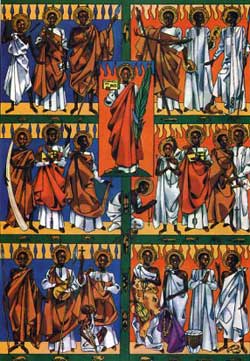
Martyrs of Uganda and Mary Glasspool
Readings:
Psalm 138 Habakkuk 2:9-14 Hebrews 10:32-39 Matthew 24:9-14Preface of Holy Week
PRAYER
O God, by whose providence the blood of the martyrs is the seed of the Church: Grant that we who remember before you the blessed martyrs of Uganda, may, like them, be steadfast in our faith in Jesus Christ, to whom they gave obedience, even unto death, and by their sacrifice brought forth a plentiful harvest; through Jesus Christ our Lord, who lives and reigns with you and the Holy Spirit, one God, for ever and ever.
Wednesday, May 26, 2010
Augustine of Canterbury
However, in the fifth century Britain was invaded by non-Christian Germanic tribes: the Angles, Saxons, and Jutes. They conquered the native Celtic Christians (despite resistance by, among others, a leader whose story has come down to us, doubtless with some exaggeration, as that of King Arthur), or drove them north and west into Cornwall, Wales, Scotland, and Ireland. From these regions Celtic Christian missionaries returned to England to preach the Gospel to the heathen invaders. Meanwhile, the Bishop of Rome, Gregory the Great, decided to send missionaries from Rome, a group of monks led by their prior, Augustine (not to be confused with the more famous Augustine of Hippo). They arrived in Kent (the southeast corner of England) in 597, and the king, whose wife was a Christian, allowed them to settle and preach. Their preaching was outstandingly successful, the people were hungry for the Good News of salvation, and they made thousands of converts in a short time. In 601 the king himself was converted and baptised. Augustine was consecrated bishop and established his headquarters at Canterbury. From his day to the present, there has been an unbroken succession of archbishops of Canterbury.
In 603, he held a conference with the leaders of the already existing Christian congregations in Britain, but failed to reach an accomodation with them, largely due to his own tactlessness, and his insistence (contrary, it may be noted, to Gregory's explicit advice) on imposing Roman customs on a church long accustomed to its own traditions of worship. It is said that the English bishops, before going to meet Augustine, consulted a hermit with a reputation for wisdom and holiness, asking him, "Shall we accept this man as our leader, or not?" The hermit replied, "If, at your meeting, he rises to greet you, then accept him, but if he remains seated, then he is arrogant and unfit to lead, and you ought to reject him." Augustine, alas, remained seated. It took another sixty years before the breach was healed.
| British stamps commemorating St. Augustine: Above, Augustine baptizing Ethelbert. Below, Augutine and his cathedral |
This, by the way, marks the beginning of the Latin Rite's ascent in the British Church. Before that time, she worshiped in a much-more Eastern fashion. (I don't say "Orthodox" because that division didn't exist for another 400 years!) There has been good work done among the Orthodox in researching the British Church's eastern connections.
Readings:
- Psalm 66:1-8
Tobit 13:1, 10-11
2 Corinthians 5:17-20a
Luke 5:1-11
Preface of Apostles
O Lord our God, who by thy Son Jesus Christ didst call thine apostles and send them forth to preach the Gospel to the nations: We bless thy holy name for thy servant Augustine, first Archbishop of Canterbury, whose labors in propagating thy Church among the English people we commemorate today; and we pray that all whom thou dost call and send may do thy will, and bide thy time, and see thy glory; through Jesus Christ our Lord, who liveth and reigneth with thee and the Holy Spirit, one God, for ever and ever.
PRAYER (contemporary language)
O Lord our God, who by your Son Jesus Christ called your apostles and sent them forth to preach the Gospel to the nations: We bless your holy name for your servant Augustine, first Archbishop of Canterbury, whose labors in propagating your Church among the English people we commemorate today; and we pray that all whom you call and send may do your will, and bide your time, and see your glory; through Jesus Christ our Lord, who lives and reigns with you and the Holy Spirit, one God, for ever and ever.
Tuesday, May 25, 2010
The Venerable Bede
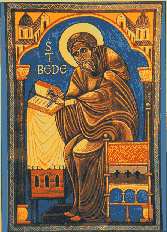
He was the first person to write scholarly works in the English language, although unfortunately only fragments of his English writings have survived. He translated the Gospel of John into Old English, completing the work on the very day of his death. He also wrote extensively in Latin. He wrote commentaries on the Pentateuch and other portions of Holy Scripture. His best-known work is his History of the English Church and People, a classic which has frequently been translated and is available in Penguin Paperbacks. It gives a history of Britain up to 729, speaking of the Celtic peoples who were converted to Christianity during the first three centuries of the Christian era, and the invasion of the Anglo-Saxon pagans in the fifth and sixth centuries, and their subsequent conversion by Celtic missionaries from the north and west, and Roman missionaries from the south and east. His work is our chief source for the history of the British Isles during this period. Fortunately, Bede was careful to sort fact from hearsay, and to tell us the sources of his information.
He also wrote hymns and other verse, the first martyrology with historical notes, letters and homilies, works on grammar, on chronology and astronomy -- he was aware that the earth is a sphere, and he is the first historian to date events ANNO DOMINI, and the earliest known writer to state that the solar year is not exactly 365 and a quarter days long, so that the Julian calendar (one leap year every four years) requires some adjusting if the months are not to get out of step with the seasons.
His hymns include one for the Ascension. Suggested tune is Agincourt, also called Deo Gratias (or Gracias), which follows:
| Clyde McLennan - Creator of the earth and skies .mp3 | ||
| | ||
| Found at bee mp3 search engine |
A hymn of glory let us sing;
New songs throughout the world shall ring:
Christ, by a road before untrod,
Now rises to the throne of God.
The holy apostolic band
Upon the Mount of Olives stand;
And with his followers they see
Their Lord's ascending majesty.
To them the angels drawing nigh,
"Why stand and gaze upon the sky?
This is the Savior," thus they say;
"This is his glorious triumph day.
"Again shall ye behold him so
As ye today have seen him go,
In glorious pomp ascending high,
Up to the portals of the sky."
O risen Christ, ascended Lord,
All praise to thee let earth accord,
Who art, while endless ages run,
With Father and with Spirit one.
Readings:
- Psalm 78:1-4
Wisdom 7:15-22
1 Corinthians 15:1-8
Matthew 13:47-52
Preface of a Saint (1)
PRAYER (contemporary wording)
h/t Satucket
Sunday, May 23, 2010
Monday, May 10, 2010
Rogationtide
While we no longer “beat the bounds of the parish,” there are ways to adapt this tradition to meet today's need for thankfulness. Rogation Days are an ideal time to remember—and rededicate our jobs, investments, and other economic activities to our Lord, in Whom we live and move and have our being, while invoking His Presence in all we do, committing our ways to Him, so that He, as promised in Scripture, guides our paths.