Showing posts with label TEC. Show all posts

Tuesday, August 31, 2010

Confessional Anglicanism is our Future


Some people allege that the Anglican Church in North America is hopelessly theologically muddled, a mere 20-year reset button on TEc, and an overly-diverse group that will fly apart as soon as the common threat of pansexualism is absent.

Archbishop Duncan says PHOOEY on that...we're in this together to confess Christ together, and our vision is still the GAFCON Jerusalem Statement.

Sunday, August 22, 2010

Global South to ECUSA and ACoC


"Think they'll get the message this time?"

No...probably not.

Sunday, June 13, 2010

Sermon Proper 6 Galatians 1:11-2:10

Sermon Galatians 2 LAPF - Fr. Chris Larimer from Fr. Chris Larimer on Vimeo.


This is the second of a series on Galatians that I'm be preaching before the Louisville Anglican Prayer Fellowship. The text is Galatians 1:11-2:10 (ESV). It also reflects on the diversity found within ACNA, centered on a unity in the gospel. And it discusses - briefly - the nature of cultural absolutism and imperialism seen in recent discussions about the Anglican Communion (especially TEC and the "African intervention").

Thursday, June 3, 2010

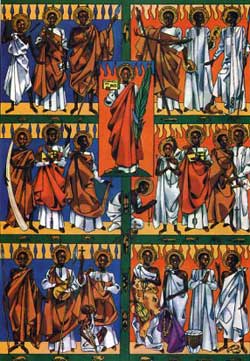
Martyrs of Uganda and Mary Glasspool

The chatter in the main TEc outlets about Uganda and its homophobia seems to forget how that nation became overwhelmingly Christian (as high as 85% in regular attendance) - the Martyrs of Uganda. I know it's conveniently left out of the discussion - how the flagrant pansexualism of The Episcopal Corp. is a true hindrance to Christians in other countries - but it's true. Even the advocates of pansexualism point out that the reason the martyrs were killed was because they refused to submit to homosexual advances by the pagan king of Buganda.

When the Global South stands up against the revisionist agenda, it isn't simply because they have Biblical disagreements; it is fueled by the living memory that resistance to the sodomite cause was the spark that set off a Spirit led revival of their nation.

Readings:

Psalm 138 Habakkuk 2:9-14 Hebrews 10:32-39 Matthew 24:9-14

Preface of Holy Week

PRAYER
O God, by whose providence the blood of the martyrs is the seed of the Church: Grant that we who remember before you the blessed martyrs of Uganda, may, like them, be steadfast in our faith in Jesus Christ, to whom they gave obedience, even unto death, and by their sacrifice brought forth a plentiful harvest; through Jesus Christ our Lord, who lives and reigns with you and the Holy Spirit, one God, for ever and ever.

Tuesday, December 29, 2009

The Final Text of the Anglican Communion Covenant: Clear Consequences

The Final Text of the Anglican Communion Covenant:

Clear Consequences

copublished, with permission, with The Living Church, and Covenant, 22 December 2009

By Dr Josiah Idowu-Fearon, Archbishop of the Province of Kaduna, Nigeria

The final text of the Covenant is the result of hard work by the various carefully selected sisters and brothers from several parts of our Communion. We appreciate and thank them for all the sacrifices made during the course of their assignments.

In the words of the Archbishop of Canterbury, the Covenant “is not going to solve all our problems, it’s not going to be a constitution, and it’s certainly not a penal code for punishing people who don’t comply.”

Members of this Communion need to be reminded that the 1998 Lambeth Conference took a position on the question of human sexuality which was revisited at the 2008 conference and reaffirmed. That position has therefore not changed. For individual dioceses that have gone against this agreed parameter we drew for ourselves, sections 4.2.5 and 4.2.8 of this final text of the Covenant are very clear on the likely consequences of their decision.

What section 4.2.8 recommends is already operational, in an analogous way, in some parts of our Communion. In the Church of Nigeria, for example, polygamists and the divorced are not officially accepted as leaders at any level and not even allowed Holy Communion. In addition, all women who are not willing to accept the discipline of this Church in holy matrimony cannot be members of the Mothers’ Union. To give them a sense of belonging, they are provided with an alternative: the Women’s Guild.

The proposed role of the Standing Committee in the Covenant (section 4.2) is an improvement on the liaison officers suggested in the Windsor Report (article 25). I hope the Standing Committee will be given all the necessary freedom and assistance to function effectively.

The Covenant gives non-Anglicans an idea of who we are and how we agree to resolve our differences as a family. I hope that bishops in every province will encourage robust debates and discussions of this final text of the Covenant. As the Archbishop of Canterbury has said, “We hope to see people agreeing to these ways of resolving our conflicts.”

__________________________________________________________________

The Most Revd Dr Josiah Idowu-Fearon is Archbishop of the Province of Kaduna, Nigeria.


Monday, December 28, 2009

The Final Text of the Anglican Communion Covenant: Four Key Questions

From Fulcrum:

The Final Text of the Anglican Communion Covenant:

Four Key Questions

copublished, with permission, with The Living Church, and Covenant, 22 December 2009

by Dr. Graham Kings, Bishop of Sherborne

Interdependence and mutual accountability have always been the key features of the earlier drafts of the Anglican Communion Covenant (Nassau, St Andrew’s, and Ridley). It is encouraging that these are still at the heart of the final text.

The working party charged with producing this text, especially focussing on section four, is to be commended. The final text is profoundly Anglican, consonant with the trajectory of the Windsor Process and, it seems to me, is likely to lead to the majority of Provinces of the Anglican Communion adopting the Covenant. In the light of recent developments, it may well be that not all Provinces will enter the Covenant. Tragically, that may be appropriate at this time.

Responses from around the Anglican Communion to the various earlier drafts have been published in full, including one from the Church of England, concerning section four of the Ridley draft. The Archbishop of Canterbury and the Secretary General of the Anglican Communion have introduced the final text.

The working party has explained their guiding principles as ‘minimal revision’ but with some ‘clearer definition’ and ‘change of tone in language’. I believe they have achieved their aim admirably.

Four key questions are now answered:

1. Can dioceses commit themselves to the Covenant? The Covenant is designed primarily for ‘Provinces of the Anglican Communion’ – these are the ‘Churches of the Anglican Communion’ referred to in the text. However, dioceses are included in the phrase ‘any ecclesial body’ and some dioceses, eg ‘Communion Partner’ dioceses in The Episcopal Church, which may wish to commit themselves to the Covenant if their Provinces do not, will be allowed to do so. The working party quote again the principles of ‘The Lambeth Commentary’ (September 2008):

“If, however, the canons and constitutions of a Province permit, there is no reason why a diocesan synod should not commit itself to the covenant, thus strengthening its commitment to the interdependent life of the Communion.”

2. Can Churches which are not yet current members of the Anglican Consultative Council affirm the Covenant (eg The Anglican Church of North America)? Yes, but this does not make them members of the ACC and future membership will be with due process (section 4.1.5).

3. What of Churches which choose not to enter into the Covenant? The text deliberately does not deal with that matter, but the working party states that the Instruments of Communion should determine an appropriate response. This may appear weak, but it seems to me to be appropriate: not being invited to conferences and commissions may be in mind.

4. Which group will be monitoring the implementation of the Covenant? In this final text, is the ‘Standing Committee of the Anglican Communion’, which recently evolved from the Joint Standing Committee of the Primates’ Meeting and the ACC (Ridley Draft).

So, after a long period of gestation the Covenant is born. Let us be encouraged and continue our support in prayer.

__________________________________________________________________

Dr Graham Kings is the Bishop of Sherborne and theological secretary of Fulcrum

Wednesday, October 21, 2009

Striving with Spong is over

John Shelby Spong, the former Episcopal Bishop of Newark, has fired his latest philippic at those who hold the Scriptural, catholic, orthodox position on the normativity of heterosexual monogamous lifelong couplings. Fr. Chris has some things to say over at his personal blog.

But here's how it ends:
To be honest, Spong's problems go much deeper than his disregard for the Scripture's teaching on homosexual behavior. His big problem is with God Almighty. Spong casts scorn on the whole notion of theism, and has such an unnuanced fundamentalist materialist bent to his mindset that he's incapable of making any sense of the Resurrection or Ascension (much less the Incarnation).

And because of that, he is to be
pitied. Because, one thing is sure - the striving is over. The battle is won, and there's no need to argue about it. Rather, it's time to simply proclaim the dogma and live into that truth. So here's some help to do just that.

Woodley Ensemble - The Strife is O'er (Palestrina)


Found at bee mp3 search engine