Please note that some Anglican Kalendars commemorate St. Joseph of Arimathaea on this day.
O GOD, who didst deliver thy holy Apostle Saint Peter from his bonds and suffer him to depart unhurt : vouchsafe, we pray thee ; to deliver us from the bonds of our sins, and of thy mercy preserve us from all evil. Through Jesus Christ, thy Son our Lord, who livest and reignest with thee, in the unity of the Holy Ghost, ever one God, world without end. Amen.

Hymn. Petrus beatus catenarum.
RIGHT wondrously set free, see, Peter freedom gains,
And at the Lord's command casts off his iron chains;
As shepherd and as guide he shews to life the way,
And from his Master's sheep drives guileful wolves away.
Now to the Trinity eternal glory sing,
All honour, virtue, might, and hymns of gladness bring.
He rules the universe in wondrous Unity,
And shall, through all the days of vast eternity. Amen.
For the legend
 THE Apostle Peter was put in prison for the Name of the Lord Jesus, and bound with Chains ; and that not once only, nor in one place, but several times, and in divers places. In the Acts of the Apostles we read how, immediately after Pentecost, he and the Apostle John went up to the temple together ; and there, at the temple gate, he healed the lame man ; and afterwards, whilst he was speaking to the people, he and John were taken by the Jewish priests, out of envy, and put in hold, that is, in Chains, unto the next day. And when they were brought forth, on the morrow, Peter shewed such constancy in his witness of Christ, along with John, that the rulers themselves could not but admire the fearless boldness of these Apostles whom they esteemed as unlearned and ignorant men. And the faith of all those who heard of this matter was in such wise strengthened by the apostolic witness, and Peter's Chains, that the number of believers increased to five thousand.
IT was not so long a time after, when all kind of diseases were healed by the shadow of Peter only, passing by, that he was taken again, and with the other Apostles was put into the common prison, at the command of the high priests and Sadducees, and thus a second time he was bound with Chains. But the Angel of the Lord by night opened the prison doors and sent the Apostles forth to preach Christ, despite the prohibition of men. Whereupon Peter and the other Apostles were apprehended, and brought before the Council, and condemned to be beaten, in an attempt to make them obey men rather than God. The third time whereof we have record of Peter's Chains is after the death of James, when Herod perceived that the murder of this Apostle was not displeasing to the Jews, and so proceeded to take Peter also, and had him bound with two Chains, and kept in prison under the ward of four quaternions of soldiers. Wherefrom he was again wondrously delivered by an Angel.
LASTLY, when he suffered martyrdom at Rome, he was kept in the Mamertine prison, and is said to have been bound in Chains by the command of Nero, which Chains have been held in honour by the Church from the first ages. Further, Arator, Subdeacon of the Roman Church in the sixth century, wrote that the Chains wherewith Peter was bound at Jerusalem, or certainly some of them, were preserved at Rome in his own time, and consequently the veneration of Peter's Chains greatly increased ; especially when, as we learn from other records of the Church of Rome, a basilica was built by the younger Eudoxia, wife of Valentinian III, on the Esquiline Hill, under the name of Saint Peter in Chains. This temple, or a re-building of it, was dedicated on August 1st, whence the day was placed in the Kalendar as the Feast of Saint Peter's Chains, afterwards called in England Lammas Day, from the custom of offering loaves of bread made from the first-gathered grain of the year, in thanksgiving from the beginning of the harvest. And, because of his Chains, this holy Apostle is often invoked for those in bondage.
From the Anglican Breviary
 Herod Agrippa, the grandson of Herod the Great and king of the Jews, grew wroth against the Church of Christ, and slew James, the brother of John the Evangelist. Seeing that this pleased the Jews, he took Peter also into custody and locked him up in prison, intending to keep him there until after the feast of the Passover, so that he could win the favour of the people by presenting him to them as a victim. But the Apostle was saved when he was miraculously set free by an Angel (Acts 12:1-19). The Chains wherewith the Apostle was bound received from his most sacred body the grace of sanctification and healing, which is bestowed upon the faithful who draw nigh with faith.
That such sacred treasures work wonders and many healings is witnessed by the divine Scripture, where it speaks concerning Paul, saying that the Christians in Ephesus had such reverence for him, that his handkerchiefs and aprons, taken up with much reverence, healed the sick of their maladies: "So that from his body were brought unto the sick handkerchiefs or aprons, and the diseases departed from them, and the evil spirits went out of them" (Acts 19:12). But not only the Apostles' clothing (which certainly touched the bodies of the sick), but even their shadow alone performed healings. On beholding this, people put their sick on stretchers and beds and brought them out into the streets that, when Peter passed by, his shadow "might overshadow some of them" (Acts 5:15). From this the Orthodox Catholic Church has learned to show reverence and piety not only to the relics of their bodies, but also in the clothing of God's Saints.
- From the Great Synaxarion by Holy Transfiguration Monastery.
 For three centuries the Chains were kept in Jerusalem, and those afflicted with illness and approached them with faith received healing. Patriarch Juvenal presented the Chains to Eudokia, wife of the emperor Theodosius the Younger, and she in turn transferred them from Jerusalem to Constantinople in either the year 437 or 439.
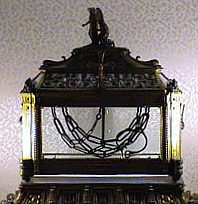
Eudokia sent one Chain to Rome to her daughter Eudokia (the wife of Valentinian), who built a church on the Esquiline Hill dedicated to the Apostle Peter and placed the Chains in it. There were other Chains in Rome, such as that which had bound the saint during his nine month imprisonment in the Mamertine Prison near the Forum, with which the Apostle Peter was shackled before his martyrdom under the Emperor Nero. These were also placed in the church. It is said that when the pope compared the two Chains, they miraculously fused together into one unbreakable series of links. Because of this miracle, Empress Eudokia built the Basilica of Saint Peter in Chains (S. Peter ad Vincula or San Pietro in Vincoli), and dedicated it to the apostle in the year 442. The relic is now kept in a golden urn beneath the high altar, close to the famous statue of Michelangelo's Moses.
The basilica has undergone several restorations and rebuildings, including a restoration by Pope Adrian I, a rebuilding by Pope Sixtus IV and another by Pope Julius II. There was also a renovation in 1875. Some modernizations were made at that time.
Michelangelo's Moses, which dates from 1515, is the most notable piece of artwork in the basilica. Originally intended as part of a 40-statue funeral monument for Pope Julius II, Moses became the Pope's funeral monument and tomb in his family's church. Further, Arator, Subdeacon of the Roman Church in the sixth century, wrote that the Chains wherewith Peter was bound at Jerusalem, or certainly some of them, were preserved at Rome in his own time, and consequently the veneration of Peter's Chains greatly increased; especially when, as we learn from other records of the Church of Rome, a basilica was built by the younger Eudokia, wife of Valentinian III, on the Esquiline Hill, under the name of Saint Peter in Chains. This temple, or a re-building of it, was dedicated on August 1st, whence the day was placed in the Roman Calendar as the Feast of Saint Peter's Chains, afterwards called in England Lammas (lit. loaf-mass) Day, from the custom of offering loaves of bread made from the first-gathered grain of the year, in thanksgiving from the beginning of the harvest. And, because of his Chains, this holy Apostle is often invoked for those in bondage.


 FIRST READING: Ezekiel 34:11-16