Showing posts with label ACNA. Show all posts

Friday, March 11, 2011

Installation at Holy Apostles in Elizabethtown

Sorry it's taken so long to post the video.

Installation of Fr. Chris Larimer from Fr. Chris Larimer on Vimeo.

This is my installation as rector of Holy Apostles Anglican Church in Elizabethtown, KY. The officiant was the Right Reverend John A. M. Guernsey, Bishop of the Diocese of the Holy Spirit (Anglican Church in North America).

Unfortunately, we ran out of memory just after the Gospel, so you missed out on his sermon. But you don't have to miss out on anything else! Worship with us at 10AM on the Public Square.

Learn more at our website.

Thursday, October 21, 2010

Letter from Archbishop Duncan

A PASTORAL LETTER ON STEWARDSHIP AND THE ANGLICAN CHURCH

TO ALL THE MEMBERS AND FRIENDS OF
THE ANGLICAN CHURCH IN NORTH AMERICA:

Dear Brothers and Sisters in Christ,

The Constitution and Canons of the Anglican Church in North America boldly proclaim that "the people of God are the chief agents of the mission of the Church" and that "the fundamental agency of mission in the Province is the local congregation." Ours is a church whose focus is on converted individuals in multiplying congregations. Ours is a church also built on the tithes of the faithful: the household to the local congregation, the local congregation to the diocese, the diocese to the Province.
Tithing and Discipleship

God led us to build our Province on committed disciples, the local congregations and the tithe: all for the purpose of reaching North America with the transforming love of Jesus Christ. The Holy Scriptures caused us to do things this way. We had (and have) a special stake in basing the whole of our life on the direction Scripture gives. While it is only one aspect of discipleship, imagine what God could do through us if all of us tithed! No congregation would any longer be "short," no diocese would lack for funds for new works, and the Province would rightly live within the tithes sent to it. We need to start challenging one another about this at the local level. God promises (Malachi 3: 8-10) to open the windows of heaven if we cease to "rob Him" and give Him our "full tithes."

If you are not already doing so, this would be a great year to take the leap. The tithe to your local congregation is the beginning point. If not yet tithing, even to move a percentage point a year over the next several years will make an amazing difference, both to the Church at every level, and most significantly to your own personal relationship with God.

Extra Mile Giving

Our Church, like Scripture itself, also teaches that the tithe is the beginning of our giving. Many of us give more than a tithe - Nara and I do so. It is all about thanksgiving to the Lord for what He has done. Some give to a point of sacrifice. They are among my heroes. Jesus and the apostolic Church most often teach either 50/50 or 100 per cent giving. Most of us who heard our friend Dr. Rick Warren of Saddleback Church speak to us at our Inaugural Assembly cannot forget the witness he and his wife make in giving away 90 percent of their income and just keeping 10 per cent. He is actually not alone in this practice that only a few can undertake, but most of us can stretch farther than we do. Pray and ask the Savior what He wants of you.

Our Provincial budget is based on the tithe of our dioceses, just as diocesan budgets are based on the tithes of their congregations. When all our local congregations get to right order, and all our dioceses get there too, we are convinced that the Province will well be able to live within these tithes for our annual operations. We have a distance to go before all our members are Biblical tithers. So at present we have a gap. For several years we know that we will have to ask some of our people and some of our congregations to "go the extra mile" beyond their tithe to help meet Provincial needs. This is not the long-term picture.

The Provincial Gap and Extra Mile Fund

The very good news is that we are almost half of the way to where we need to be to fund the base-line Provincial work. That is quite an accomplishment given the fact that the Province was only birthed 16 months ago! For now I need to ask for "extra-mile" giving to fill the gap.

At the August Executive Committee meeting an "Extra Mile Fund" was established to stand alongside "the Founders' Fund." Gifts to each - beyond your tithe to your own parish - will make it possible for our Province to be well launched in these "gap" years in which I will be serving you as first archbishop. Parishes that are able are also asked to consider gifts - beyond their diocesan tithe - to the Extra Mile or Founders' Funds.

Individuals and parishes are asked to consider a direct gift to the Province this year, and perhaps during several of the next years. We do not yet have all our households and congregations tithing, but as discipleship improves the need will diminish. This is the Archbishop's gap appeal. Individual and parish gifts directed for the ACNA of up to $10,000 will be credited to the Extra-Mile Fund. Gifts over $10,000 will be credited to the Founders' Fund. We need some $480,000 for this year's operation on top of the $900,000 already committed by dioceses, parishes and individuals. Please remember that the Province is providing both direct and subsidiary support to 20 Dioceses and more than 640 congregations in North America.

Help me, please, in these "gap" years to be your archbishop and do what the Provincial Council believes is essential. We started a year ago as a Province and have come a very great distance. For the long-haul, tithe and teach the tithe and the windows of heaven will be open for your parish, your diocese and our province, as well.

God bless you each and every one.

Faithfully in Christ,


Archbishop and Primate

[1] Canon I. 10, Section 1
[1] Constitution Article IV, point 1.
[1] Canon I. 9, Section 1 and Canon I. 10, Section 2, point 5.

[1] Typical are Lk 3:11; Lk 12:33-34; Acts 2:44-45; Acts 5:40-42; Lk 9:23-24.

P.S.

If you wish to be part of the Extra Mile Fund there are two ways to make a contribution:


You can send a check payable to:
Anglican Church in North America
800 Maplewood Ave.
P.O. Box 447
Ambridge, PA 15003

Please note in Memo section: "Extra Mile Fund"

Or contribute online at : http://anglicanchurch.net/?/main/donate

Saturday, October 9, 2010

Foley Beach and Robert Grosseteste

I'm in Atlanta for the consecration of Dr. Foley Beach to the holy episcopate. It's an exciting day for me because this is also the Feast of St. Robert Grosseteste. Grosseteste was an Oxford scholar and pastor before he was appointed bishop of Lincoln. After his episcopal consecration, he surprised his diocese by actually taking the lead in caring for the priests and parishioners under his care. He visited the rural deaneries (way out in the country) and taught the clergy at diocesan synods. Instead of simply making decrees from his episcopal seat and hoping they would be carried out, he visited parishes and told the clergy why certain decisions were made. He refused to admit men to livings (pastoral appointments with a certain income) if he knew they would be sub-letting their cure (paying a poor curate to perform their pastoral duties). That form of abuse was rampant in the medieval church, but Grosseteste even refused to admit a nephew of the pope to a living when he saw that the man was unfit.

Auspiciously, today the Anglican Church is again being given a bishop who is a faithful pastor, a stalwart defender of the faith, a capable teacher, and a true pastor to pastors in raising Foley Beach to the Sacred Order of Bishops. He is surrounded by people who can testify to his commitment to see people's lives changed for the sake of the Gospel. He maintains a full teaching / speaking role even while serving as rector of a growing church. And he has discipled so many young men in their role as presbyters in the Church of God. I couldn't be happier to be here. I couldn't be happier to be part of this movement.

Let all faithful Anglicans thank God for the example of Robert Grosseteste, and his spiritual heir, Foley Beach.

Holy God, our greatest treasure, you blessed Hugh and Robert, Bishops of Lincoln, with wise and cheerful boldness for the proclamation of your Word to rich and poor alike: Grant that all who minister in your Name may serve with diligence, discipline and humility, fearing nothing but the loss of you and drawing all to you through Jesus Christ our Savior; who lives and reigns with you in the communion of the Holy Spirit, one God, now and for ever. Amen.

Tuesday, August 31, 2010

Confessional Anglicanism is our Future


Some people allege that the Anglican Church in North America is hopelessly theologically muddled, a mere 20-year reset button on TEc, and an overly-diverse group that will fly apart as soon as the common threat of pansexualism is absent.

Archbishop Duncan says PHOOEY on that...we're in this together to confess Christ together, and our vision is still the GAFCON Jerusalem Statement.

Wednesday, August 25, 2010

The Coming ACNA Prayer Book


I have a feeling that some of the AC-NA folks are going to be really upset no matter what form the prayer book revision takes. Let's hope it's received better than the BCP was received in Scotland!

Wednesday, February 10, 2010

CofE General Synod Affirms ACNA


from ACNA:

Today, the General Synod, the national assembly of the Church of England, meeting in London February 8-12, affirmed the Anglican Church in North America’s desire “to remain within the Anglican family.”

The Most Rev. Robert Duncan, archbishop of the Anglican Church in North America, thanked Mrs. Lorna Ashworth of Chichester for bringing the church to the attention of the General Synod. “We are very grateful to Mrs. Ashworth and the scores of other friends in the Synod of the Church of England for all they did to give us this opportunity to tell our story to the mother church of the Anglican Communion. It is very encouraging that the synod recognizes and affirms our desire to remain within the Anglican family.” said Archbishop Duncan.

A private member’s motion, put forward by Mrs. Ashworth, and subsequently amended by the Synod, states that “this synod…recognize and affirm the desire of those who have formed the Anglican Church in North America to remain within the Anglican family.” The motion passed by a resounding 309 – 69 margin (with seven abstentions).

The motion was amended by the Right Reverend Michael Hill, the Bishop of Bristol. His purpose, in his own words, was “(1) to encourage those who are part of the Anglican Church in North America; (2) to commend the process of recognition afforded by the Instruments of the Anglican Communion; and (3) to ask the Archbishop of Canterbury to report progress back to Synod in a year’s time.”

The discussion at Synod presented an important opportunity for members of the Anglican Church in North America, joined by many friends in the United Kingdom, to share the vision and mission of the church with fellow Anglicans. “We are deeply thankful that we were given the opportunity to tell the Synod about our church, and our vision for reaching North America with the transforming love of Jesus Christ. This chance to speak directly to our Anglican family was very rewarding. We look forward to working with the friends we made and reaching out to others in the years ahead,” said Bishop Donald Harvey, who, with Mrs. Cynthia Brust, Dr. Michael Howell, and the Rev. Dr. Tory Baucum, represented the Anglican Church in North America in preparation for the Synod vote.

Tuesday, December 29, 2009

The Final Text of the Anglican Communion Covenant: Clear Consequences

The Final Text of the Anglican Communion Covenant:

Clear Consequences

copublished, with permission, with The Living Church, and Covenant, 22 December 2009

By Dr Josiah Idowu-Fearon, Archbishop of the Province of Kaduna, Nigeria

The final text of the Covenant is the result of hard work by the various carefully selected sisters and brothers from several parts of our Communion. We appreciate and thank them for all the sacrifices made during the course of their assignments.

In the words of the Archbishop of Canterbury, the Covenant “is not going to solve all our problems, it’s not going to be a constitution, and it’s certainly not a penal code for punishing people who don’t comply.”

Members of this Communion need to be reminded that the 1998 Lambeth Conference took a position on the question of human sexuality which was revisited at the 2008 conference and reaffirmed. That position has therefore not changed. For individual dioceses that have gone against this agreed parameter we drew for ourselves, sections 4.2.5 and 4.2.8 of this final text of the Covenant are very clear on the likely consequences of their decision.

What section 4.2.8 recommends is already operational, in an analogous way, in some parts of our Communion. In the Church of Nigeria, for example, polygamists and the divorced are not officially accepted as leaders at any level and not even allowed Holy Communion. In addition, all women who are not willing to accept the discipline of this Church in holy matrimony cannot be members of the Mothers’ Union. To give them a sense of belonging, they are provided with an alternative: the Women’s Guild.

The proposed role of the Standing Committee in the Covenant (section 4.2) is an improvement on the liaison officers suggested in the Windsor Report (article 25). I hope the Standing Committee will be given all the necessary freedom and assistance to function effectively.

The Covenant gives non-Anglicans an idea of who we are and how we agree to resolve our differences as a family. I hope that bishops in every province will encourage robust debates and discussions of this final text of the Covenant. As the Archbishop of Canterbury has said, “We hope to see people agreeing to these ways of resolving our conflicts.”

__________________________________________________________________

The Most Revd Dr Josiah Idowu-Fearon is Archbishop of the Province of Kaduna, Nigeria.


Monday, December 28, 2009

The Final Text of the Anglican Communion Covenant: Four Key Questions

From Fulcrum:

The Final Text of the Anglican Communion Covenant:

Four Key Questions

copublished, with permission, with The Living Church, and Covenant, 22 December 2009

by Dr. Graham Kings, Bishop of Sherborne

Interdependence and mutual accountability have always been the key features of the earlier drafts of the Anglican Communion Covenant (Nassau, St Andrew’s, and Ridley). It is encouraging that these are still at the heart of the final text.

The working party charged with producing this text, especially focussing on section four, is to be commended. The final text is profoundly Anglican, consonant with the trajectory of the Windsor Process and, it seems to me, is likely to lead to the majority of Provinces of the Anglican Communion adopting the Covenant. In the light of recent developments, it may well be that not all Provinces will enter the Covenant. Tragically, that may be appropriate at this time.

Responses from around the Anglican Communion to the various earlier drafts have been published in full, including one from the Church of England, concerning section four of the Ridley draft. The Archbishop of Canterbury and the Secretary General of the Anglican Communion have introduced the final text.

The working party has explained their guiding principles as ‘minimal revision’ but with some ‘clearer definition’ and ‘change of tone in language’. I believe they have achieved their aim admirably.

Four key questions are now answered:

1. Can dioceses commit themselves to the Covenant? The Covenant is designed primarily for ‘Provinces of the Anglican Communion’ – these are the ‘Churches of the Anglican Communion’ referred to in the text. However, dioceses are included in the phrase ‘any ecclesial body’ and some dioceses, eg ‘Communion Partner’ dioceses in The Episcopal Church, which may wish to commit themselves to the Covenant if their Provinces do not, will be allowed to do so. The working party quote again the principles of ‘The Lambeth Commentary’ (September 2008):

“If, however, the canons and constitutions of a Province permit, there is no reason why a diocesan synod should not commit itself to the covenant, thus strengthening its commitment to the interdependent life of the Communion.”

2. Can Churches which are not yet current members of the Anglican Consultative Council affirm the Covenant (eg The Anglican Church of North America)? Yes, but this does not make them members of the ACC and future membership will be with due process (section 4.1.5).

3. What of Churches which choose not to enter into the Covenant? The text deliberately does not deal with that matter, but the working party states that the Instruments of Communion should determine an appropriate response. This may appear weak, but it seems to me to be appropriate: not being invited to conferences and commissions may be in mind.

4. Which group will be monitoring the implementation of the Covenant? In this final text, is the ‘Standing Committee of the Anglican Communion’, which recently evolved from the Joint Standing Committee of the Primates’ Meeting and the ACC (Ridley Draft).

So, after a long period of gestation the Covenant is born. Let us be encouraged and continue our support in prayer.

__________________________________________________________________

Dr Graham Kings is the Bishop of Sherborne and theological secretary of Fulcrum

Sunday, December 13, 2009

COMMUNIQUÉ FROM THE FIRST ANNUAL PROVINCIAL COUNCIL

Posted December 11, 2009 at 5:26 PM

Grateful for the gracious guidance of the Holy Spirit and the leadership of the Most Reverend Robert Duncan, Archbishop and Primate, the Provincial Council of the Anglican Church in North America (ACNA) held its first annual meeting in Toronto, Canada on 11 December 2009. The College of Bishops of ACNA met immediately prior to this meeting in Burlington, Ontario on 10 December 2009.

The Provincial Council is the governing body of the Anglican Church in North America and consists of bishops, clergy and laity representing each of the twenty-eight constituent dioceses, clusters or networks.

The Provincial Council and the College of Bishops devoted these first meetings to putting in place the officers and structures necessary to fulfill the mandate to reach North America with the transforming love of Jesus Christ as faithful Anglicans and members by God's grace in the One Holy Catholic and Apostolic Church of Jesus Christ.

In faithful obedience to the Great Commission we enthusiastically embraced the 1000 Churches Proclamation as presented to the College of Bishops by the Rev. Canon David H. Roseberry of Christ Church, Plano, Texas, and committed ourselves to the multiplication of one thousand new congregations within the Anglican Church in North America in five years.

We also

  • Welcomed the new Diocese of the Gulf Atlantic and consented to the election of the Reverend Neil G. Lebhar as its first diocesan bishop. The College of Bishops also welcomed the Right Reverends Todd Hunter, David M. Loomis and Silas Tak Yin Ng as missionary bishops serving in the Anglican Mission in the Americas, the Right Reverend Harry S. Seamans as an Assisting Bishop in the Diocese of Mid-America and the Right Reverend Richard W. Lipka as an assisting bishop in the Missionary Diocese of All Saints.
  • (Ed. - Bp. Lipka was the president of the Communion of Christ the Redeemer, a sort of "holding tank" for former CEC bishops, clergy, and congregations who were waiting for the establishment of the AC-NA.)
  • Gave thanks for the growing number of Provinces of the Anglican Communion that have declared themselves to be in full communion with the Anglican Church in North America, and the enthusiastic expressions of support from a growing number of Ecumenical partners.
  • Expressed profound appreciation for the recently released Manhattan Declaration that affirms core Christian values regarding Religious Liberty, the Sanctity of Life and Holy Matrimony and urged all clergy and people to sign it.
  • And, mindful of the controversy surrounding a bill concerning homosexual behavior that is being considered by the Uganda parliament, restated our commitment to the sacredness of every human person as made in the image of God, from conception to natural death and without regard for religious convictions or manner of life. We also gave thanks for the faithful witness of the Anglican Church of Uganda and encouraged them to stand firm against all forms of sexual exploitation and in their publicly stated commitment that “the Church is a safe place” for all persons, especially “those struggling with sexual brokenness.”

The Provincial Council expressed its profound appreciation for the gracious hospitality shown it by the Anglican Network in Canada and in particular gave thanks for the servant leadership demonstrated by the moderator, the Right Reverend Donald Harvey.

Looking forward to the Christmas Season and the celebration of the birth of Jesus the Christ the Council was reminded that the angels announced it as Good News of Great Joy for all people. In light of this the Council urged all its congregations to make a special effort to reach out with the transforming love of Jesus Christ, especially to those in their surrounding communities who face economic hardship, or other challenges that lead to their marginalization.

This first meeting of the Provincial Council has been a rich expression of our common life. We leave encouraged in our mission to extend the Kingdom of God through Jesus Christ.

Friday, November 13, 2009

New South Wales Province reaches out to AC-NA

Not sure how I missed this one!

On the final night of the 2009 Synod, the Anglican Diocese of Sydney has passed a resolution embracing the new Anglican province, the Anglican Church in North America (ACNA).

In the words of the resolution “Synod welcomes the creation of the Province of the Anglican Church in North America (ACNA) under the leadership of Archbishop Bob Duncan and notes the GAFCON Primates’ Council recognition of the ACNA as genuinely Anglican and its recommendation that Anglican Provinces affirm full communion with the ACNA. Synod therefore expresses its desire to be in full communion with the ACNA.’

The resolution also asks the Standing Committee of the diocese to seek a General Synod motion affirming the national church be in full communion with the ACNA.

In moving the motion, Sydney rector Gavin Poole, who spent time in the US working at an Episcopal Church, spoke of his first hand experience with the liberalism of TEC and paid tribute to what he called ‘the courage of Archbishop Duncan’.

“Canterbury may be blind to them, but we see them and embrace them. Please offer the ACNA your right hand of fellowship” Mr Poole told the Synod.

The motion also asks General Synod Standing committee to note the publication of the Jerusalem Declaration and to encourage its study as a means to Anglican identity and cohesion.

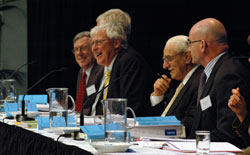
Photo: Archbishop Jensen and diocesan officials during debate.

The motion was seconded by Sydney layman Robert Tong who helped in the creation of the province as a consultant to its governance taskforce.

Mr Tong was also at GAFCON when the Jerusalem Declaration was formulated and hailed it as “a clear statement about Anglican identity and coherence and based clearly on scripture.”

The resolution also contains a section on the recent Vatican offer to disenfranchised Anglicans.

The motion “Welcomes Archbishop Duncan’s assessment that the recent Vatican offer of a Personal Ordinariate ‘will not be utilised by the great majority of the Anglican Church in North America’s bishops, priests, dioceses and congregations’ and urges all Anglicans to reject the Vatican’s proposal”.

The President of the Anglican Church League, Dr Mark Thompson described that as an important part of the statement, even though it was a separate issue to the welcoming of the new province.

“The opportunity of the moment is to forge new understandings with orthodox Anglicans from different traditions – anglo-catholic, evangelical, charismatic - and through a principled co-operation, and the emphasis needs to be on principle, to rescue the denomination from the liberal agenda to which it has been captive for over 50 years” Dr Thompson said.

The motion was carried on the voices in the last hour of Synod.
I very much appreciate this recognition. But there is something troubling to me. Sydney has a disturbing history on the issue of Holy Orders and the Lord's Supper. In the past, there has been vocal support for Lay Presidency at the Lord's Supper(an issue which Spong of Newark supported in his Why Christianity must Change or Die). And there are current suits against the archdiocese on the issue of Diaconal Presidency.

These issues are every bit as grave a threat to catholic order as are the more flash-point problems of women and gays.

Friday, October 23, 2009

Nearly 40 Congregations Join the Anglican Church in North America

In just three months, the Anglican Church in North America has welcomed 39 new congregations. When the Anglican Church in North America officially launched in late June, it included 703 churches in the United States and Canada. Today, there are 742 congregations affiliated with the Anglican Church.

A number of the new congregations are recent church plants, like St. Barnabas in Covington, Kentucky. According to Fr. Christopher Peterson (picture at right - Ed.), who leads St. Barnabas, the young church held its first worship service on June 7. Just a few months into their life, St. Barnabas has already benefited greatly from its relationship with other Anglican Church in North America congregations in Kentucky, said Peterson. He and other members of the launch team have also been amazed by the way God has sent people to St. Barnabas. “It is not like we have found a lot of people, but that people have found us. It is astounding,” said Peterson.

More information about St. Barnabas is available online at http://www.kentuckyanglican.com

Calling together new congregations is a key goal for The Anglican Church in North America. “We are convinced that the Good News of Jesus Christ and the transforming power of His love offer life-change wherever they are preached. Vibrant, multiplying local congregations are both the primary tool to fulfill that important evangelical task and the natural result of our friends and neighbors responding to the Gospel,” said Archbishop Duncan.

Formed in June of 2009, the Anglican Church in North America unites 742 Anglican congregations into a single Anglican Province. The church’s mission is to reach North America with the Transforming Love of Jesus Christ.

Source