Showing posts with label sacrament. Show all posts

Thursday, October 7, 2010

Neo-Nazis Become Orthodox Jews

CNN is playing a documentary on a couple of Polish Neo-Nazis who discovered that they were actually Jews. Their families had hidden their ethnicity & religion during the Nazi era. Now, they have converted to Orthodox Judaism!

It's amazing what we forget about who we truly are. We were created in the image of God. Those who passed through the baptismal waters have had that image repristinated by being grafted into Christ.

What would happen if the Church - you and me and all the baptized - were to, like this couple, rediscover who we really are? Would it require a radical break with who we were? Would it require a reorientation of our priorities? Our daily life?

What would need to change for you?

Tuesday, February 16, 2010

Lenten Discipline - Frequent Communion


"The person that goes regularly and intelligently to the Lord's Table finds it increasingly hard to yield to sin and conform to the world."

~ J.C. Ryle, first Bishop of Liverpool


You will have multiple opportunities for Table Fellowship with Our Lord this Lent - on Sundays and Wednesdays. I have found that since joining a sacramental church, my personal holiness has increased. I attribute this directly to receiving the Body & Blood of Our Lord, with the assurances of an apostolic priesthood. (When I was in a non-apostolic church, we still received weekly - but I'd be more inclined to say "weakly" since it did not have the sanctifying effect it has on me now.)

Monday, January 11, 2010

Did you remember your baptism?

Then you're not only remembering what happened to you, but to Jesus and to all Israel (that is, all the covenant people of God). Jesus was baptized to identify with us - and in our baptism, we are identified with him. As Paul wrote, if we die with him in our baptism, we rise with him in his resurrection.

This song has been in my heart ever since Sunday (which was an AWESOME time with Bp. Ilgenfritz). I thought you'd appreciate it as well. (Note, the music is 6v where the song is only three...so sing it twice!)
Clyde McLennan - Rise, my soul, to watch and pray .mp3


Found at bee mp3 search engine

Tuesday, December 15, 2009

Reflecting on John the Baptist's ministry

...and he was baptized at once, he and all his family. (Acts 16:33)

Over the years, I’ve grown increasingly uncomfortable with calling the forerunner of Jesus “John the Baptist.” Sometimes I’ll call him John the Baptizer; other times, John the Forerunner. The reason, of course, is that calling him “John the Baptist” sounds to some ears like “John the Lutheran” or “John the Presbyterian” or “John the Methodist.” That is, they hear a denominational distinctive rather than the man who paved the way for the coming of the Lord who is over the whole church.

This is especially dangerous for those of us who are liturgical, as we will always encounter John in the wilderness of Advent. On more than one occasion I’ve heard ordained clergymen from Anglican, Lutheran, Presbyterian, and Methodist churches saying that believers baptism is “more biblical” than infant baptism, and I’ve even seen some Anglican churches “dedicating” rather than baptizing infants.

Plenty of ink has already been spilled over the exegetical arguments for (and against) household baptisms, so I don’t plan to revisit those (brief review here). Instead, I want to draw your attention to a couple of the theological implications of infant baptism (a.k.a. paedobaptism or covenant baptism), implications which are very practical.

First, infant baptism says that salvation is about what God has done, rather than what we have done. For those who insist on adult baptism, the key element seems to be the free will “decision” one has made to follow God. By contrast, infant baptism testifies clearly to God’s sovereign work in salvation and regeneration, and His faithfulness to His promises. It underscores the reality of original sin, and puts on display the fact that God alone is able to bring us into His family. Like an infant being brought forth for the sacrament, we’ve done nothing to merit God’s favor. I can't underscore this enough: infant baptism teaches that salvation is not the result of our works. Grace alone (sola gratia) is truly catholic doctrine!

Second, infant baptism testifies that our children are real, genuine members of God’s kingdom. They are not little pagans that need converting - rather, we can bring them up as Christians, and safely presume that they are saved until (God forbid) they give clear evidence otherwise. Such a doctrine is enormously practical, and can give a great deal of comfort to anxious parents. It’s part of our Communion’s recovery of the historic practice of paedocommunion - and a salutary correlate to our pro-life stance.

I really don’t believe that Anglican leaders have any liberty in this area, as infant baptism is plainly taught in Article 27. Beyond that, I’m convinced that the practice is perfectly scriptural. Read the venerable Browne if you don't believe me.

So baptize those babies!

Friday, November 13, 2009

New South Wales Province reaches out to AC-NA

Not sure how I missed this one!

On the final night of the 2009 Synod, the Anglican Diocese of Sydney has passed a resolution embracing the new Anglican province, the Anglican Church in North America (ACNA).

In the words of the resolution “Synod welcomes the creation of the Province of the Anglican Church in North America (ACNA) under the leadership of Archbishop Bob Duncan and notes the GAFCON Primates’ Council recognition of the ACNA as genuinely Anglican and its recommendation that Anglican Provinces affirm full communion with the ACNA. Synod therefore expresses its desire to be in full communion with the ACNA.’

The resolution also asks the Standing Committee of the diocese to seek a General Synod motion affirming the national church be in full communion with the ACNA.

In moving the motion, Sydney rector Gavin Poole, who spent time in the US working at an Episcopal Church, spoke of his first hand experience with the liberalism of TEC and paid tribute to what he called ‘the courage of Archbishop Duncan’.

“Canterbury may be blind to them, but we see them and embrace them. Please offer the ACNA your right hand of fellowship” Mr Poole told the Synod.

The motion also asks General Synod Standing committee to note the publication of the Jerusalem Declaration and to encourage its study as a means to Anglican identity and cohesion.

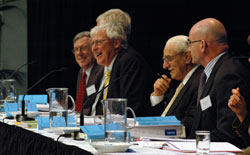
Photo: Archbishop Jensen and diocesan officials during debate.

The motion was seconded by Sydney layman Robert Tong who helped in the creation of the province as a consultant to its governance taskforce.

Mr Tong was also at GAFCON when the Jerusalem Declaration was formulated and hailed it as “a clear statement about Anglican identity and coherence and based clearly on scripture.”

The resolution also contains a section on the recent Vatican offer to disenfranchised Anglicans.

The motion “Welcomes Archbishop Duncan’s assessment that the recent Vatican offer of a Personal Ordinariate ‘will not be utilised by the great majority of the Anglican Church in North America’s bishops, priests, dioceses and congregations’ and urges all Anglicans to reject the Vatican’s proposal”.

The President of the Anglican Church League, Dr Mark Thompson described that as an important part of the statement, even though it was a separate issue to the welcoming of the new province.

“The opportunity of the moment is to forge new understandings with orthodox Anglicans from different traditions – anglo-catholic, evangelical, charismatic - and through a principled co-operation, and the emphasis needs to be on principle, to rescue the denomination from the liberal agenda to which it has been captive for over 50 years” Dr Thompson said.

The motion was carried on the voices in the last hour of Synod.
I very much appreciate this recognition. But there is something troubling to me. Sydney has a disturbing history on the issue of Holy Orders and the Lord's Supper. In the past, there has been vocal support for Lay Presidency at the Lord's Supper(an issue which Spong of Newark supported in his Why Christianity must Change or Die). And there are current suits against the archdiocese on the issue of Diaconal Presidency.

These issues are every bit as grave a threat to catholic order as are the more flash-point problems of women and gays.