Showing posts with label church. Show all posts

Wednesday, February 22, 2017

Historic and True Anglicanism

The Rev'd Dr. Percy Dearmer
“The English Church happens to base herself in a special manner upon history–she appeals to the Scriptures and primitive antiquity for her theology, [* Articles VI., VIII., etc.] to the ancient Fathers for her ritual, [* The Preface Concerning the Service of the Church, Article XXIV., etc.] to Catholic tradition for her ceremonial; [* The Preface Of Ceremonies, Canon 30 (1603), Canon & (1640), etc.] she refers us to the second year of Edward VI for her ornaments, [* The Ornaments Rubric] and to the later middle ages for the arrangement of her chancels. [* "And the chancels shall remain as they have done in times past." (First inserted in 1552.)] [24/25] Her formularies, therefore, cannot be understood without a good deal of historical knowledge. Some people may object to this, and may ask–Why should they be bound by documents that are two or three hundred years old? But the fact remains that they are so bound, whether they like it or not; and that the whole intention of the Reformers, as shown from end to end of the Prayer Book, Articles, and Canons, was to bind them to principles that are nearer two thousand than two hundred years of age. Nor will they be released from this bondage to historic continuity till the same authority that imposed it shall have removed it,–which will not be for a long time to come. The attempts that have been hitherto made at throwing off this light yoke have not been so conspicuously successful in their results as to encourage us to proceed. Therefore I ask Churchmen to renounce those futile experiments of private judgment, and to throw themselves into the task of realising in its entirety that sound Catholic ideal which the defenders of the English Church preserved for us through the most troublous period of her history."
– The Rev'd Dr. Percy Dearmer
Loyalty to the Prayer Book

Thursday, October 7, 2010

Neo-Nazis Become Orthodox Jews

CNN is playing a documentary on a couple of Polish Neo-Nazis who discovered that they were actually Jews. Their families had hidden their ethnicity & religion during the Nazi era. Now, they have converted to Orthodox Judaism!

It's amazing what we forget about who we truly are. We were created in the image of God. Those who passed through the baptismal waters have had that image repristinated by being grafted into Christ.

What would happen if the Church - you and me and all the baptized - were to, like this couple, rediscover who we really are? Would it require a radical break with who we were? Would it require a reorientation of our priorities? Our daily life?

What would need to change for you?

Monday, August 9, 2010

Church Lights - Their Use and Meaning

Church lights (candles) symbolize God’s Presence in the sanctuary and the spiritual enlightenment His Gospel brings our lives. Roman practice differs slightly, but in the main carries the same symbolism. Looking at the chancel (by the communion rails) in most churches, we see two major lights. First on the Gospel (left side) we see a small red light mounted on the wall. This is the Altar Lamp that burns in honor of the constant Real Presence in the reserve Sacrament (consecrated wine and host) kept in the tabernacle / aumbry - a small, ornate box centered on the back portion of the Holy Table. or on a wall nearby.


The other major lights are the candles on the Holy Table, divided into two groups, signifying Jesus in both His divine and human natures. At many parishes, you’ll see two groups of three each on the back of the Table, called “Office Lights,” lit when conducting the offices of the Church, such as Morning/Evening Prayer, Holy Matrimony, or Funeral services. In other parishes, there will simply be two larger pillar candles beside the Holy Table which are lit for the same purpose.


The two lights in front of these - or directly on the table - are the Communion Lights, used during the Eucharist. All the lights echo Christ’s words, when He said, “I am the Light of the World” (St. John 8:12) and other passages referring to God’s light, such as St. Matt. 4:16 and St. Luke 2:32.


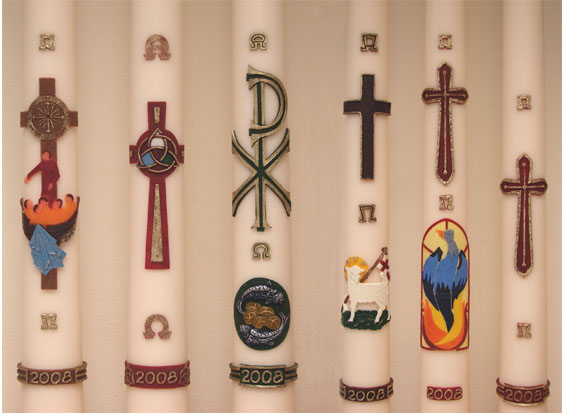
The last light in many churches is the Paschal Candle. This is a large white candle normally kept our of sight, or next to the baptismal font. The candle is blessed every year at the Easter Vigil service, having the year inscribed on it and (traditionally) five grains of incense inserted into in in the shape of a cross. It is often decorated with other signs of the resurrection as well. Some parishes - especially those with elaborate Holy Saturday / Easter Vigil services - have special rituals surrounding the entrance of the Paschal candle. These rituals can include chanting the Exultet (normally done by a deacon), dipping the base of the candle in the baptismal font, and using this candle to light the tapers that will ignite the rest of the office and communion lights. (This practice is especially important in parishes that light a Paschal fire near the entrance of the church door for the vigil.) The candle is brought to the front of the church from Easter until the Ascension (when its removal visually symbolizes Christ's immediate light being taken from our presence). Then the candle is either stored or kept near the font. However, for baptisms and funerals (which, for Christians, is the completion of our baptismal death into Christ), the candle returns to a prominent place. I should also note that this is a Western / Latin Rite practice. The East uses a different type of candle. However, this practice antedates Jerome - and was clearly a common practice long before the Council of Nicea.


The candles recall times when ancient Christians met at night to avoid discovery and needed the lights to worship, but are retained to remind us of those days and to focus us on our Heavenly Father of Lights. Scriptural authority is solid for their use—found in Ex 25:31 & 40:25, Lev 24:2 & II Chron 13:11— and reminds us—we carry the Light of Christ!

Thursday, November 19, 2009

A Living Church

Cross-posted from Fr. Chris' personal blog.

“When the Church takes account of only the present, she does nothing but change; if she looks only to the future, she does nothing but dream; only when she is conscious of being the living tradition of Christ is she truly renewed.”

Anthony Burton, former bishop of Saskatchewan

Lord, give us eyes to see
both what we have been,
and what we shall be.

Saturday, October 31, 2009

Reunion UNDER Rome on Reformation Day

Thoughts about why reunion under the bishop of Rome isn't the truly catholic way forward at Fr. Chris' blog (today and throughout the week).

It's Halloween

Our parish newsletter featured an article of Fr. Chris' take on Halloween. If you'd like a copy, just email me.

There've been some newsworthy blips on the Halloween scene detailed at his personal blog. Synopsis:

Get your candy exorcised, but don't expect a Roman priest to do it for you.

Speaking of that, Happy Reformation Day!

Thursday, October 22, 2009

Per the recent statements from Rome

Is best taken from Anglican Divine, Bp. Jeremy Taylor (sometimes known as the "Shakespeare of Divines" for his poetic style of expression):
"What can be supposed wanting in our Church in order to salvation? We have the Word of God, the Faith of the Apostles, the Creeds of the Primitive Church, the Articles of the four first General Councils, a holy liturgy, excellent prayers, perfect sacraments, faith and repentance, the Ten Commandments, and the sermons of Christ, and all the precepts and counsels of the Gospels. We … require and strictly exact the severity of a holy life. … We communicate often, our priests absolve the penitent. Our Bishops ordain priests, and confirm baptised persons, and bless their people and intercede for them. And what could here, be wanting to salvation?”

- Jeremy Taylor, Bp. of Down & Connor (1613-1667)

Tuesday, October 20, 2009

Apostolic Constitution for Unity with the See of Rome

From the See of Rome, the Vatican:
NOTE OF THE CONGREGATION FOR THE DOCTRINE OF THE FAITH ABOUT PERSONAL ORDINARIATES FOR ANGLICANS ENTERING THE CATHOLIC CHURCH

With the preparation of an Apostolic Constitution, the Catholic Church is responding to the many requests that have been submitted to the Holy See from groups of Anglican clergy and faithful in different parts of the world who wish to enter into full visible communion.

In this Apostolic Constitution the Holy Father has introduced a canonical structure that provides for such corporate reunion by establishing Personal Ordinariates, which will allow former Anglicans to enter full communion with the Catholic Church while preserving elements of the distinctive Anglican spiritual and liturgical patrimony. Under the terms of the Apostolic Constitution, pastoral oversight and guidance will be provided for groups of former Anglicans through a Personal Ordinariate, whose Ordinary will usually be appointed from among former Anglican clergy.

The forthcoming Apostolic Constitution provides a reasonable and even necessary response to a world-wide phenomenon, by offering a single canonical model for the universal Church which is adaptable to various local situations and equitable to former Anglicans in its universal application. It provides for the ordination as Catholic priests of married former Anglican clergy. Historical and ecumenical reasons preclude the ordination of married men as bishops in both the Catholic and Orthodox Churches. The Constitution therefore stipulates that the Ordinary can be either a priest or an unmarried bishop. The seminarians in the Ordinariate are to be prepared alongside other Catholic seminarians, though the Ordinariate may establish a house of formation to address the particular needs of formation in the Anglican patrimony. In this way, the Apostolic Constitution seeks to balance on the one hand the concern to preserve the worthy Anglican liturgical and spiritual patrimony and, on the other hand, the concern that these groups and their clergy will be integrated into the Catholic Church.

Cardinal William Levada, Prefect of the Congregation for the Doctrine of the Faith which has prepared this provision, said: "We have been trying to meet the requests for full communion that have come to us from Anglicans in different parts of the world in recent years in a uniform and equitable way. With this proposal the Church wants to respond to the legitimate aspirations of these Anglican groups for full and visible unity with the Bishop of Rome, successor of St. Peter."

These Personal Ordinariates will be formed, as needed, in consultation with local Conferences of Bishops, and their structure will be similar in some ways to that of the Military Ordinariates which have been established in most countries to provide pastoral care for the members of the armed forces and their dependents throughout the world. "Those Anglicans who have approached the Holy See have made clear their desire for full, visible unity in the one, holy, catholic and apostolic Church. At the same time, they have told us of the importance of their Anglican traditions of spirituality and worship for their faith journey," Cardinal Levada said.

The provision of this new structure is consistent with the commitment to ecumenical dialogue, which continues to be a priority for the Catholic Church, particularly through the efforts of the Pontifical Council for the Promotion of Christian Unity. "The initiative has come from a number of different groups of Anglicans," Cardinal Levada went on to say: "They have declared that they share the common Catholic faith as it is expressed in the Catechism of the Catholic Church and accept the Petrine ministry as something Christ willed for the Church. For them, the time has come to express this implicit unity in the visible form of full communion."

According to Levada: "It is the hope of the Holy Father, Pope Benedict XVI, that the Anglican clergy and faithful who desire union with the Catholic Church will find in this canonical structure the opportunity to preserve those Anglican traditions precious to them and consistent with the Catholic faith. Insofar as these traditions express in a distinctive way the faith that is held in common, they are a gift to be shared in the wider Church. The unity of the Church does not require a uniformity that ignores cultural diversity, as the history of Christianity shows. Moreover, the many diverse traditions present in the Catholic Church today are all rooted in the principle articulated by St. Paul in his letter to the Ephesians: ‘There is one Lord, one faith, one baptism’ (4:5). Our communion is therefore strengthened by such legitimate diversity, and so we are happy that these men and women bring with them their particular contributions to our common life of faith."

Background information

Since the sixteenth century, when King Henry VIII declared the Church in England independent of Papal Authority, the Church of England has created its own doctrinal confessions, liturgical books, and pastoral practices, often incorporating ideas from the Reformation on the European continent. The expansion of the British Empire, together with Anglican missionary work, eventually gave rise to a world-wide Anglican Communion.

Throughout the more than 450 years of its history the question of the reunification of Anglicans and Catholics has never been far from mind. In the mid-nineteenth century the Oxford Movement (in England) saw a rekindling of interest in the Catholic aspects of Anglicanism. In the early twentieth century Cardinal Mercier of Belgium entered into well publicized conversations with Anglicans to explore the possibility of union with the Catholic Church under the banner of an Anglicanism "reunited but not absorbed".

At the Second Vatican Council hope for union was further nourished when the Decree on Ecumenism (n. 13), referring to communions separated from the Catholic Church at the time of the Reformation, stated that: "Among those in which Catholic traditions and institutions in part continue to exist, the Anglican Communion occupies a special place."

Since the Council, Anglican-Roman Catholic relations have created a much improved climate of mutual understanding and cooperation. The Anglican-Roman Catholic International Commission (ARCIC) produced a series of doctrinal statements over the years in the hope of creating the basis for full and visible unity. For many in both communions, the ARCIC statements provided a vehicle in which a common expression of faith could be recognized. It is in this framework that this new provision should be seen.

In the years since the Council, some Anglicans have abandoned the tradition of conferring Holy Orders only on men by calling women to the priesthood and the episcopacy. More recently, some segments of the Anglican Communion have departed from the common biblical teaching on human sexuality—already clearly stated in the ARCIC document "Life in Christ"—by the ordination of openly homosexual clergy and the blessing of homosexual partnerships. At the same time, as the Anglican Communion faces these new and difficult challenges, the Catholic Church remains fully committed to continuing ecumenical engagement with the Anglican Communion, particularly through the efforts of the Pontifical Council for the Promotion of Christian Unity.

In the meantime, many individual Anglicans have entered into full communion with the Catholic Church. Sometimes there have been groups of Anglicans who have entered while preserving some "corporate" structure. Examples of this include, the Anglican diocese of Amritsar in India, and some individual parishes in the United States which maintained an Anglican identity when entering the Catholic Church under a "pastoral provision" adopted by the Congregation for the Doctrine of the Faith and approved by Pope John Paul II in 1982. In these cases, the Catholic Church has frequently dispensed from the requirement of celibacy to allow those married Anglican clergy who desire to continue ministerial service as Catholic priests to be ordained in the Catholic Church.

In the light of these developments, the Personal Ordinariates established by the Apostolic Constitution can be seen as another step toward the realization the aspiration for full, visible union in the Church of Christ, one of the principal goals of the ecumenical movement.

[01517-02.01]

And from the See of Canterbury:

Joint Statement by The Archbishop of Westminster and The Archbishop of Canterbury

mardi 20 octobre 2009

Today's announcement of the Apostolic Constitution is a response by Pope Benedict XVI to a number of requests over the past few years to the Holy See from groups of Anglicans who wish to enter into full visible communion with the Roman Catholic Church, and are willing to declare that they share a common Catholic faith and accept the Petrine ministry as willed by Christ for his Church.

Pope Benedict XVI has approved, within the Apostolic Constitution, a canonical structure that provides for Personal Ordinariates, which will allow former Anglicans to enter full communion with the Catholic Church while preserving elements of distinctive Anglican spiritual patrimony.

The announcement of this Apostolic Constitution brings to an end a period of uncertainty for such groups who have nurtured hopes of new ways of embracing unity with the Catholic Church. It will now be up to those who have made requests to the Holy See to respond to the Apostolic Constitution.

The Apostolic Constitution is further recognition of the substantial overlap in faith, doctrine and spirituality between the Catholic Church and the Anglican tradition. Without the dialogues of the past forty years, this recognition would not have been possible, nor would hopes for full visible unity have been nurtured. In this sense, this Apostolic Constitution is one consequence of ecumenical dialogue between the Catholic Church and the Anglican Communion.

The on-going official dialogue between the Catholic Church and the Anglican Communion provides the basis for our continuing cooperation. The Anglican Roman Catholic International Commission (ARCIC) and International Anglican Roman Catholic Commission for Unity and Mission (IARCCUM) agreements make clear the path we will follow together.

With God's grace and prayer we are determined that our on-going mutual commitment and consultation on these and other matters should continue to be strengthened. Locally, in the spirit of IARCCUM, we look forward to building on the pattern of shared meetings between the Catholic Bishops Conference of England and Wales and the Church of England's House of Bishops with a focus on our common mission. Joint days of reflection and prayer were begun in Leeds in 2006 and continued in Lambeth in 2008, and further meetings are in preparation. This close cooperation will continue as we grow together in unity and mission, in witness to the Gospel in our country, and in the Church at large.

+ Vincent + Rowan

As our Forward in Faith brethren pray, Ut unum sint!