Today is the commemoration of William Tyndale and Miles Coverdale, translators of the Holy Scriptures into English. Tyndale's New Testament served as the basis for the populace of England being converted to Justification by Grace through Faith. Coverdale, whose Psalm translation still deeply effects the BCP's psalms, came along and published an Old Testament / Apocrypha along with a slightly altered Tyndale NT. This Bible was the first to receive broad use in England and can still be read today.
Let us render hearty thanks to God for these two servants. And let us take up their cause by reading the Scriptures for ourselves in "a language understanded of the people" and applying it to our lives.
COLLECT: Almighty God, you planted in the heart of your servants William Tyndale and Miles Coverdale a consuming passion to bring the Scriptures to people in their native tongue, and endowed them with the gift of powerful and graceful expression and with strength to persevere against all obstacles: Reveal to us your saving Word, as we read and study the Scriptures, and hear them calling us to repentance and life; through Jesus Christ our Lord, who lives and reigns with you and the Holy Spirit, one God, for ever and ever. Amen.
Below is an excellent video that gives an accessible visual rendering of the history of the English Bible.
Showing posts with label reformation. Show all posts
Showing posts with label reformation. Show all posts
Wednesday, October 6, 2010


Saturday, September 25, 2010
Peace at Augsburg
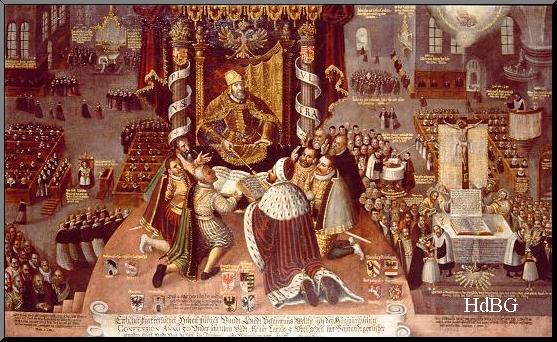
In many ways, the Reformation was not merely a change in the religious landscape, but also a renovation of the entire social order. Economics were impacted, education swelled, and the missionary impulse brought Europeans into increasing contact with other cultures - and conflict with other Europeans. Great was the turmoil and many the monstrous crimes committed in the name of Christ in the wake of the Reformation. Religious passions quickly passed into political conflict. No place was this more true than in Germany, where peasants rioted at the behest of the radical Anabaptists. And, of course, Luther's alliance with certain Prince-Electors was a sore spot for the Roman Catholic aligned Holy Roman Emperor, Charles V.

At the Diet (a formal assembly of princes) of Worms in 1521, Emperor Charles V outlawed Lutheranism . But he was unable to stamp out the reform movement at the time because of other crises. Not until 1529 was Charles able to follow up on the Lutheran issue. He sent word that Catholicism was to be restored everywhere in Germany. Many German cities and princes protested. These were called the "Protesting estates" and from them we got the name "Protestant."
Charles saw that some sort of conciliation would be in order. In 1530 he attended an assembly known as the Diet at Augsburg.

Lutherans presented the Confession of Augsburg (authored principally by Philip Melancthon) in an attempt to prove to Rome that their views were Biblical. This confession remains the basis of the Lutheran faith. However, reconciliation proved impossible and Charles ordered Lutherans to reunite with the Catholic church by April 15, 1531. This had the effect of stiffening opposition against him. A military alliance of Protestants, known as the Schmalkaldic League came into being. Charles crushed this, but Elector Maurice switched sides and declared war on the emperor, forcing him to negotiate with the Protestants. In 1552, at the Peace of Passau, Charles accepted the existence of the evangelical church and promised to hold a "diet" to settle the controversy.

The diet was not convened until 1555. Again it was held in Augsburg. Peace was arranged between the Lutherans and Catholics on this day, September 25, 1555. In many respects it was imperfect. Although Lutherans were given legal standing, Anabaptists and Calvinists were not. "[A]ll such as do not belong to the two above-named religions shall not be included in the present peace but be totally excluded from it." Each German territory must take the faith of its prince. This inbuilt religious divisiveness crippled Germany's ability to unite as a nation. There was no toleration within a territory.
The Peace of Augsburg did, however, permit people to transplant to a region whose faith was more congenial to each. "In case our subjects, whether belonging to the old religion or to the Augsburg Confession, should intend leaving their homes, with their wives and children, in order to settle in another place, they shall neither be hindered in the sale of their estates after due pay, net of the local taxes nor injured in their honor... "

The Peace of Augsburg offered the merest hint of toleration. Weak as was the treaty, it brought increased stability. However, not until the Peace of Westphalia in 1648 were Calvinists added to the list of tolerated religions.
Bibliography:
- "Augsburg, Peace of." The Oxford Dictionary of the Christian Church. Edited by F. L. Cross and E. A. Livingstone. Oxford, 1997.
- Durant, Will. The Reformation; A history of European civilization from Wyclif to Calvin: 1300 - 1564. The Story of Civilization, Part VI. New York: Simon and Schuster, 1957.
- Kidd, B. J. Documents illustrative of the Continental Reformation; edited by B. J. Kidd. Oxford, Clarendon Press, 1967.
- Simon, Edith and the editors of Time/Life. The Reformation. Great Ages of Man. New York: Time Inc., 1966.
- Various encyclopedia articles & websites.
Wednesday, November 18, 2009
Sticking Around
 The doctrinal history of the Church of England asserts that it is both Catholic and Reformed; Apostolic and Evangelical; Prophetic and Protestant. The Prayer Book states: ‘Whosoever will be saved, it is necessary above all things that he hold the catholic faith...’. Anglicanism is a worldwide universal communion, and repudiates some of the claims of Rome, not least its soteriology, ecclesiology, its unique claim to catholicity and and its understanding of authority.
Unless salvation has ceased to be by faith; unless church governance has ceased to be synodical; unless infallible moral authority has indeed been imparted by God to one man, the doctrinal claims of the Church of England, founded on natural law through tradition, reason and experience, have as much validity now as they had four centuries ago. And let it not be forgotten that when Richard Hooker wrote The Laws Of Ecclesiastical Polity, Pope Clement VIII said of the book: "It has in it such seeds of eternity that it will abide until the last fire shall consume all learning."
The Anglican ship might have a lousy captain in the current ABC, but her bow is sound. And if she be holed beneath the waterline, let us rather reach for a bucket and repair the damage before simply abandoning her to the rocks and waves.
Thursday, November 12, 2009
Here's a selection from a Sermon preached at General Convention. No...not a recent one. Rather, one held shortly after the founding of the Protestant Episcopal Church (as opposed to the Church of England), in 1786. by William White, DD (soon to be elected Bishop of Pennsylvania, then later to serve as the Presiding Bishop). In it, he wished to show that the Protestant Episcopal Church was still in union with the catholic church - even as she established some judicatory independence from the Church of England - because she continued in the faith & practices delivered from the apostles.
Some persons in power of other religious jurisdictions have recently claimed that they represent the historic Anglican witness to Jesus on American soil - and that the real heretics (parters-of-way with the church catholic) are those who insist that God has a plan of saving individuals. This person may believe what she likes, but needs to know that she is out of step the institution she claims to represent, and has long-since parted ways with the church catholic.
 As for the rest of us, with the release of the Vatican documents paving the way to Rome, I urge us all to consider the price. We are already part of the catholic church. We simply don't recognize the universal & immediate jurisdictional authority of the bishop of Rome over all other dioceses, synods, and provinces of the One, Holy, Catholic and Apostolic Church. We are seeking greater visible unity with other members of that church (as recent talks with the SCOBA affirm). But it must be unity - not supremacy; it must be welcome - not walking-mat.
I encourage us all to reclaim our catholicity and hold tenaciously to the root faith that makes us all one in Jesus Christ.
BY the christian doctrine, I mean that which hath been held by the whole church, notwithstanding all the superstition and enthusiasm which have in different times and places in part obscured its lustre.
YES; however various the opinions of professing christians, there are in the holy scriptures the outlines of a system which nothing could obliterate: Conspicuous truths, which have been always seen and confessed by the great body of professing christians.
THAT there is one infinitely perfect God the Father; and one Lord Jesus Christ, God begotten of God, and thus possessed of all divine attributes, who having been "in the beginning and before all worlds," took in time man's nature upon him, to make in it an oblation for sin; and one Holy Spirit, who, being sent by the Father and the Son assists mankind by his inspirations; that these three divine agents are essentially united, as well in themselves, as in accomplishing the work of redemption; that the end of the gospel dispensation is to rescue man from the darkness and corruption of fallen nature, making him through faith acceptable to God, and enabling him to live in good works; and that the result of all is the bringing of those who shall believe in Christ with a faith evidencing itself in holiness to the everlasting happiness of heaven, which can be claimed only through his merits; are truths which have been never lost sight of by the visible church: They were indited by that blessed Spirit, who was to "lead her into all truth," and the upholding of them is essential to the accomplishment of the promise, "that the same divine Comforter should continue with her for ever."
THERE is therefore a doctrine which hath been at all times acknowledged; and it is "the inward glory of the King's daughter," the intrinsic worth of our holy religion.
AND here we have the true ground of church unity: Of the only unity fought for in the early ages; when the different churches of Christendom, knowing no other common head than Christ, lived in an happy agreement in the same faith under their respective Bishops, and in a delightful communion founded on that agreement.
HOW important then is the preservation of a faith thus maintained by the Catholic Christian world! And how great should be our caution, lest, by loosening ourselves from the common tie of the communion of saints, we cease to be a member of that body of which Christ vouchsafeth to call himself the head: A part of that church, in which he hath promised to be present "even unto the end of the world!"

Notice that he cautioned us to be careful lest - as an institution - we fall away from the core of the Faith and cease to be part of the Church. Dr. White, himself an old-style evangelical, didn't say that the faith is to be found solely in that expression of the Church. But rather that in all places where these truths are taught unblemished and unapologetically, there you have the communion of saints.
Some persons in power of other religious jurisdictions have recently claimed that they represent the historic Anglican witness to Jesus on American soil - and that the real heretics (parters-of-way with the church catholic) are those who insist that God has a plan of saving individuals. This person may believe what she likes, but needs to know that she is out of step the institution she claims to represent, and has long-since parted ways with the church catholic.
 As for the rest of us, with the release of the Vatican documents paving the way to Rome, I urge us all to consider the price. We are already part of the catholic church. We simply don't recognize the universal & immediate jurisdictional authority of the bishop of Rome over all other dioceses, synods, and provinces of the One, Holy, Catholic and Apostolic Church. We are seeking greater visible unity with other members of that church (as recent talks with the SCOBA affirm). But it must be unity - not supremacy; it must be welcome - not walking-mat.
I encourage us all to reclaim our catholicity and hold tenaciously to the root faith that makes us all one in Jesus Christ.
Tuesday, November 10, 2009
Church Society response to Anglicanorum Coetibus
 From the Church Society
According to its own doctrinal standards and history, the Church of England's true nature is that of a Protestant, Reformed, Evangelical and catholic (in other words, universal) church. Orthodox Anglicanism is therefore defined by reference to these characteristics only, which are set out in the Thirty-nine Articles and the Church of England's submission to the over-arching authority of Scripture alone. Church Society seeks to defend and promote these defining characteristics, especially the Gospel of salvation by grace alone, through faith alone, in Christ alone which is at the heart of the message and mission of the Church of England.
While acknowledging the correct stand taken by Anglo-Catholics against theological liberalism (the features of which do not represent true, Biblical Anglicanism), it should also be noted that the true doctrine of the Church of England does not embrace any of the teachings or practices which characterise the Church of Rome. (as opposed to those being truly catholic / universal. - Fr. Chris) For instance, the Church of Rome is fundamentally flawed in its claims about its own nature and authority and in its teaching about the means of salvation.
A proper rejection of theological liberalism should therefore not be accompanied by a turning to the Church of Rome and its unbiblical teachings and practices. Rather, both theological liberalism and the unscriptural teachings and practices of the Church of Rome are contrary to the Bible and to the historic doctrines of the Church of England as a Protestant, Reformed, Evangelical and catholic church.
The longing of Church Society is that all Anglicans, whether in England or elsewhere, would see and understand both the destructive nature of theological liberalism and the false nature, teachings and practices of the Church of Rome.
We grieve that the Church of England, along with our nation, has fallen so low in its spiritual and moral condition. We pray that God would pour out His Spirit on both church and nation.
We rejoice that salvation is by grace alone, through faith alone, in Christ alone and we pray that the Church of England will return to full adherence to its doctrinal standards, acknowledging the supreme authority of the Bible as God's Word and seeking to shape its teaching and practices by what He has revealed.
Further information relevant to this statement can be found here. We do no good to give up the traditions of deconstructionists & revisionists for the traditions of Romanists. While there can be legitimate debate about the place of the Patriarch of Rome within the great ancient patriarchal sees (Jerusalem, Antioch, Alexandria, Constantinople, and Rome), it is against catholic principles for him to demand immediate jurisdictional and episcopal governance over all Christians everywhere - or to say that he is infallible. Especially in the absence of synodical ratification.
Thursday, November 5, 2009
Diversity & Tolerance

If you immediately condemn anyone who doesn’t quite believe the same as you do as forsaken by Christ’s Spirit, and consider anyone to be the enemy of truth who holds something false to be true, who, pray tell, can you still consider a brother? I for one have never met two people who believed exactly the same thing. This holds true in theology as well.
- Martin Bucer
To my friends who insist that AC-NA will spin apart because of evangelical and catholic and charismatic Anglicans coming together, I say: PHOOEY. How much more classically Anglican can you get than Martin Bucer, a man who started out as a Dominican priest and worked tirelessly to bringing conciliation among the leading lights of the Lutheran, Genevan/Swiss, & English Reformations?
Saturday, October 31, 2009
Reunion UNDER Rome on Reformation Day
Thoughts about why reunion under the bishop of Rome isn't the truly catholic way forward at Fr. Chris' blog (today and throughout the week).
Subscribe to:
Posts (Atom)