Saturday, October 9, 2010

Foley Beach and Robert Grosseteste

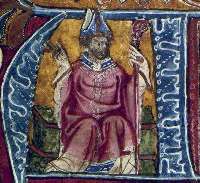
I'm in Atlanta for the consecration of Dr. Foley Beach to the holy episcopate. It's an exciting day for me because this is also the Feast of St. Robert Grosseteste. Grosseteste was an Oxford scholar and pastor before he was appointed bishop of Lincoln. After his episcopal consecration, he surprised his diocese by actually taking the lead in caring for the priests and parishioners under his care. He visited the rural deaneries (way out in the country) and taught the clergy at diocesan synods. Instead of simply making decrees from his episcopal seat and hoping they would be carried out, he visited parishes and told the clergy why certain decisions were made. He refused to admit men to livings (pastoral appointments with a certain income) if he knew they would be sub-letting their cure (paying a poor curate to perform their pastoral duties). That form of abuse was rampant in the medieval church, but Grosseteste even refused to admit a nephew of the pope to a living when he saw that the man was unfit.

Auspiciously, today the Anglican Church is again being given a bishop who is a faithful pastor, a stalwart defender of the faith, a capable teacher, and a true pastor to pastors in raising Foley Beach to the Sacred Order of Bishops. He is surrounded by people who can testify to his commitment to see people's lives changed for the sake of the Gospel. He maintains a full teaching / speaking role even while serving as rector of a growing church. And he has discipled so many young men in their role as presbyters in the Church of God. I couldn't be happier to be here. I couldn't be happier to be part of this movement.

Let all faithful Anglicans thank God for the example of Robert Grosseteste, and his spiritual heir, Foley Beach.

Holy God, our greatest treasure, you blessed Hugh and Robert, Bishops of Lincoln, with wise and cheerful boldness for the proclamation of your Word to rich and poor alike: Grant that all who minister in your Name may serve with diligence, discipline and humility, fearing nothing but the loss of you and drawing all to you through Jesus Christ our Savior; who lives and reigns with you in the communion of the Holy Spirit, one God, now and for ever. Amen.

Thursday, October 7, 2010

Neo-Nazis Become Orthodox Jews

CNN is playing a documentary on a couple of Polish Neo-Nazis who discovered that they were actually Jews. Their families had hidden their ethnicity & religion during the Nazi era. Now, they have converted to Orthodox Judaism!

It's amazing what we forget about who we truly are. We were created in the image of God. Those who passed through the baptismal waters have had that image repristinated by being grafted into Christ.

What would happen if the Church - you and me and all the baptized - were to, like this couple, rediscover who we really are? Would it require a radical break with who we were? Would it require a reorientation of our priorities? Our daily life?

What would need to change for you?

Wednesday, October 6, 2010

Ten Cheers for Tyndale

Today is the commemoration of William Tyndale and Miles Coverdale, translators of the Holy Scriptures into English. Tyndale's New Testament served as the basis for the populace of England being converted to Justification by Grace through Faith. Coverdale, whose Psalm translation still deeply effects the BCP's psalms, came along and published an Old Testament / Apocrypha along with a slightly altered Tyndale NT. This Bible was the first to receive broad use in England and can still be read today.

Let us render hearty thanks to God for these two servants. And let us take up their cause by reading the Scriptures for ourselves in "a language understanded of the people" and applying it to our lives.

COLLECT: Almighty God, you planted in the heart of your servants William Tyndale and Miles Coverdale a consuming passion to bring the Scriptures to people in their native tongue, and endowed them with the gift of powerful and graceful expression and with strength to persevere against all obstacles: Reveal to us your saving Word, as we read and study the Scriptures, and hear them calling us to repentance and life; through Jesus Christ our Lord, who lives and reigns with you and the Holy Spirit, one God, for ever and ever. Amen.

Below is an excellent video that gives an accessible visual rendering of the history of the English Bible.

Wednesday, September 29, 2010

A Hymn for Michaelmas

On the Feast of Michael and all Angels, popularly called Michaelmas, we give thanks for the many ways in which God's loving care watches over us, both directly and indirectly, and we are reminded that the richness and variety of God's creation far exceeds our knowledge of it.

The Holy Scriptures often speak of created intelligences other than humans who worship God in heaven and act as His messengers and agents on earth. We are not told much about them, and it is not clear how much of what we are told is figurative. Jesus speaks of them as rejoicing over penitent sinners (Lk 15:10). Elsewhere, in a statement that has been variously understood (Mt 18:10), He warns against misleading a child, because their angels behold the face of God. (Acts 12:15 may refer to a related idea.)

In the Hebrew Scriptures, it is occasionally reported that someone saw a man who spoke to him with authority, and who he then realized was no mere man, but a messenger of God. Thus we have a belief in super-human rational created beings, either resembling men in appearance or taking human appearance when they are to communicate with us. They are referred to as "messengers of God," or simply as "messengers." The word for a messenger in Hebrew is MALACH, in Greek, ANGELOS, from which we get our word "angel" [ Digression: ANGELION means "message, news" and EUANGELION means "good news = goodspell = gospel," from which we get our word "evangelist" used to mean a preacher of the Good News of salvation, and, more narrowly, one of the four Gospel-writers: Matthew, Mark, Luke, and John.]

By the time of Christ, Jewish popular belief included many specifics about angels, with names for many of them. There were thought to be four archangels, named Michael, Gabriel, Raphael, and Uriel. An alternative tradition has seven archangels (see Tobit 12:15 and 1 Enoch 20). Sometimes each archangel is associated with one of the seven planets of the Ptolemaic system (the moon, Mercury, Venus, the Sun, Mars, Jupiter, Saturn). Michael is associated with Saturn and Uriel with the Sun. The other pairings I forget, but I believe that you will find a list in the long narrative poem called "The Golden Legend," by Henry Wadsworth Longfellow. (I believe that a pairing is also offered in the opening chapters of the Proof of The Apostolic Preaching, by Irenaeus of Lyons, but I have not the work at hand.)

Michael (the name means "Who is like God?") is said to be the captain of the heavenly armies. He is mentioned in the Scriptures in Daniel 10:13,31; 12:1 (where he is said to be the prince of the people of Israel); in Jude 9 (where he is said to have disputed with the devil about the body of Moses); and in Revelation 12:7 (where he is said to have led the heavenly armies against those of the great dragon). In iconography, he is generally pictured in full armor, carrying a lance, and with his foot on the neck of a dragon. Oftentimes, his lance pierces the mouth of the serpent, as this demonstrates the power of truth to conquer the Father of Lies. (Pictures of the Martyr George are often similar, but only Michael has wings.)

Gabriel (the name means "God is my champion") is thought of as the special bearer of messages from God to men. He appears in Daniel 8:16; 9:21 as an explainer of some of Daniel's visions. According to the first chapter of Luke, he announced the forthcoming births of John the Baptist and of our Lord to Zachariah and the Virgin Mary respectively.

Raphael (the name means "God heals") is mentioned in the Apocrypha, in the book of Tobit, where, disguised as a man, he accompanies the young man Tobias on a quest, enables him to accomplish it, and gives him a remedy for the blindness of his aged father.

Uriel (the name means "God is my light" -- compare with "Uriah", which means "the LORD is my light") is mentioned in 4 Esdras.

It is thought by many scholars that the seven lamps of Revelation 4:5 are an image suggested by (among many other things) the idea of seven archangels.

What is the value to us of remembering the Holy Angels? Well, since they appear to excel us in both knowledge and power, they remind us that, even among created things, we humans are not the top of the heap. Since it is the common belief that demons are angels who have chosen to disobey God and to be His enemies rather than His willing servants, they remind us that the higher we are the lower we can fall. The greater our natural gifts and talents, the greater the damage if we turn them to bad ends. The more we have been given, the more will be expected of us. And, in the picture of God sending His angels to help and defend us, we are reminded that apparently God, instead of doing good things directly, often prefers to do them through His willing servants, enabling those who have accepted His love to show their love for one another.


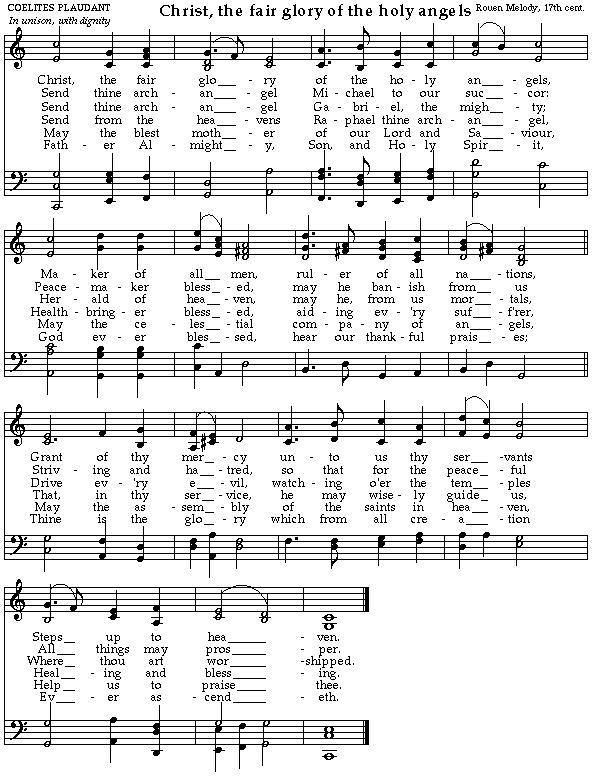
Coelites Plaudant - 5 verses, C


Found at bee mp3 search engine

Saturday, September 25, 2010

Peace at Augsburg


In many ways, the Reformation was not merely a change in the religious landscape, but also a renovation of the entire social order. Economics were impacted, education swelled, and the missionary impulse brought Europeans into increasing contact with other cultures - and conflict with other Europeans. Great was the turmoil and many the monstrous crimes committed in the name of Christ in the wake of the Reformation. Religious passions quickly passed into political conflict. No place was this more true than in Germany, where peasants rioted at the behest of the radical Anabaptists. And, of course, Luther's alliance with certain Prince-Electors was a sore spot for the Roman Catholic aligned Holy Roman Emperor, Charles V.

At the Diet (a formal assembly of princes) of Worms in 1521, Emperor Charles V outlawed Lutheranism . But he was unable to stamp out the reform movement at the time because of other crises. Not until 1529 was Charles able to follow up on the Lutheran issue. He sent word that Catholicism was to be restored everywhere in Germany. Many German cities and princes protested. These were called the "Protesting estates" and from them we got the name "Protestant."

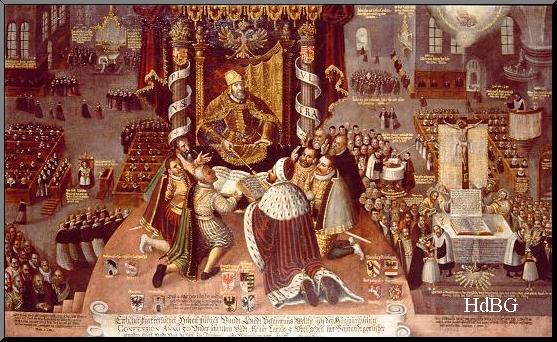
Charles saw that some sort of conciliation would be in order. In 1530 he attended an assembly known as the Diet at Augsburg.
Lutherans presented the Confession of Augsburg (authored principally by Philip Melancthon) in an attempt to prove to Rome that their views were Biblical. This confession remains the basis of the Lutheran faith. However, reconciliation proved impossible and Charles ordered Lutherans to reunite with the Catholic church by April 15, 1531. This had the effect of stiffening opposition against him. A military alliance of Protestants, known as the Schmalkaldic League came into being. Charles crushed this, but Elector Maurice switched sides and declared war on the emperor, forcing him to negotiate with the Protestants. In 1552, at the Peace of Passau, Charles accepted the existence of the evangelical church and promised to hold a "diet" to settle the controversy.

The diet was not convened until 1555. Again it was held in Augsburg. Peace was arranged between the Lutherans and Catholics on this day, September 25, 1555. In many respects it was imperfect. Although Lutherans were given legal standing, Anabaptists and Calvinists were not. "[A]ll such as do not belong to the two above-named religions shall not be included in the present peace but be totally excluded from it." Each German territory must take the faith of its prince. This inbuilt religious divisiveness crippled Germany's ability to unite as a nation. There was no toleration within a territory.

The Peace of Augsburg did, however, permit people to transplant to a region whose faith was more congenial to each. "In case our subjects, whether belonging to the old religion or to the Augsburg Confession, should intend leaving their homes, with their wives and children, in order to settle in another place, they shall neither be hindered in the sale of their estates after due pay, net of the local taxes nor injured in their honor... "


The Peace of Augsburg offered the merest hint of toleration. Weak as was the treaty, it brought increased stability. However, not until the Peace of Westphalia in 1648 were Calvinists added to the list of tolerated religions.

Bibliography:

  1. "Augsburg, Peace of." The Oxford Dictionary of the Christian Church. Edited by F. L. Cross and E. A. Livingstone. Oxford, 1997.
  2. Durant, Will. The Reformation; A history of European civilization from Wyclif to Calvin: 1300 - 1564. The Story of Civilization, Part VI. New York: Simon and Schuster, 1957.
  3. Kidd, B. J. Documents illustrative of the Continental Reformation; edited by B. J. Kidd. Oxford, Clarendon Press, 1967.
  4. Simon, Edith and the editors of Time/Life. The Reformation. Great Ages of Man. New York: Time Inc., 1966.
  5. Various encyclopedia articles & websites.

Thursday, September 23, 2010

Religion in the Recession

A troubled warden approached his pastor and said, "We've got serious problems. Our members don't invite people to church. Our members don't give enough to pay the bills."

The pastor said, "As you know, my job is spiritual development. You'll have to bring that up with our evangelism and finance committees."

The warden returned not long after that and said, "Things are getting worse. Attendance is down. Giving is down. We might not be able to pay the staff!"

The pastor said, "Why didn't you tell me it was that serious? But as you know, my job is spiritual development. We'll have to bring up these problems at our next vestry meeting."

Immediately at the start of the vestry meeting, the warden stood up and said, "Pastor, we have a spiritual problem in our church."

America does not have a failing economy.

America's churches don't have attendance and money problems.

Our spiritual problem is being exposed.

2 Chronicles 7:14.

Wednesday, September 22, 2010